HOME | ABOUT US | Speaker | Americans Together | Videos | www.CenterforPluralism.com | Please note that the blog posts include my own articles plus selected articles critical to India's cohesive functioning. My articles are exclusively published at www.TheGhouseDiary.com You can send an email to: MikeGhouseforIndia@gmail.com


Sunday, July 21, 2019

The Indian synagogues preserved by Muslims

Every time I read about Indian Jews leaving India, I wish they had not, then I realized that I have left India too, but of course, Indian blood runs in my veins. Two of the famous Indian Actors were David, who went to Canada, and Nadira (Film AAN fame with Dilip Kumar) died in 2016.
Mike

The Indian synagogues preserved by Muslims

By Kalpana Prodhan & Sreya Chatterjee 18 April 2019
Courtesy BBC News 
For more than 100 years, the synagogues in Kolkata, India, have been cared for by Muslims in a shining example of friendship uniting faith.
Pictures courtesy Getty’s image
       

Birth of the ‘Baghdadis’

For nearly 140 years, from 1772 to 1911, Kolkata was the capital of British India – a bustling commercial city on the bank of the Hugli River in the heart of West Bengal. Its strategic position, roughly 150km upstream from the Bay of Bengal, not only brought foreign trade, but also enticed several foreign communities – from Chinese to Armenians to Greeks – to migrate to the thriving city. Among them were Jews from the Middle East.
Known as ‘Baghdadis’ or ‘Baghdadi Jews’ because of their origins in modern-day Iraq, Syria and other Arabic-speaking places, Jewish immigrants began settling in Kolkata in 1798 after a trader named Shalom Cohen came in search of riches. As news spread of Cohen’s success in the trade of diamonds, silk, indigo, opium and cotton, Kolkata’s Jewish population grew rapidly, and by the early 1900s, thousands of Jews were living harmoniously alongside Kolkata’s many Hindus and Muslims.

Disappearing act

After World War Two, as many as 5,000 Jews resided in Kolkata. During the community’s peak in the 1940s, Kolkata was home to five synagogues, as well many Jewish businesses, newspapers and schools. Today, what was once India’s largest Judaic community has dwindled to fewer than 24 people, as many Baghdadi Jews have immigrated to Israel, the US, Britain, Canada and Australia.
Yet, while Kolkata’s Judaic population ages and shrinks, its remaining community continues a cross-cultural tradition that has existed for the past three generations: its three remaining houses of worship are maintained and cared for by Muslim men.

Family across faiths

Climbing the marble staircase and pushing past the stained glass window of Kolkata’s Beth El Synagogue, built in 1856, visitors may come across a rare sight: a team of four white-clad Muslim men busy polishing the wooden balconies, sweeping the chequered marble floors and ensuring that the Star of David and seven-pointed menorah adorning the building’s sand-coloured facade are clean.
Several of the caretakers, such as Siraj Khan, a third-generation Muslim employee whose family has been maintaining the synagogue for more than 120 years, have grown up alongside Beth El’s few remaining members. According to AM Cohen, general secretary of Kolkata’s Jewish Community Affairs, Khan and the other Muslim caretakers of the city’s synagogues are considered part of the Jewish family.

Religious relatives

Just 300m from Beth El, one of Kolkata’s other remaining synagogues, Magen David, a towering Italian Renaissance-style red-brick building, is also maintained by four different Muslim men whose families have looked over the temple for generations. Like at Beth El, after the caretakers unlock the doors and turn on the altar lights, illuminating Hebrew inscriptions of the Ten Commandments, the workers often gather in a courtyard to unfurl a prayer rug towards Mecca and bend in prostration to Allah.
According to Jael Silliman, one of Kolkata’s last remaining Jews and author of the digital archive Recalling Jewish Calcutta, which aims to preserve the memories and legacy of the city’s Jewish community, there has always been a cultural familiarity between Muslims and Jews in Kolkata, as the earliest Jewish immigrants to the city spoke Judeo-Arabic and wore Arabic attire.
Beyond Kolkata, the two religions have a long history of overlap. Fittingly, during the tumultuous years before and during World War Two, many European Jews fled Nazi Germany and found safe refuge in Kolkata. Like their Jewish Middle-Eastern predecessors, these newly arrived European refugees soon found that they had a lot in common with the Muslims who made up Kolkata’s largest minority group – from similarities between kosher and halal food to their music and dance.

Special bond

“God is everywhere, be it a mosque, temple, church or synagogue, and working in this quaint synagogue is a service to God that I do wholeheartedly,” said Khan (pictured), whose grandfather and father cared for the Beth El Synagogue, and who now maintains it alongside his brother.
“His name or form is not to be differentiated when the language of love and kindness is spoken. And this special bond is what I feel with this synagogue.”

Melting pot

West Bengal is home to India’s third-highest concentration of Muslims, and Kolkata, its capital, has always been something of a haven for religious tolerance. While the majority of the 4.5 million population is Hindu, Muslims, Christians, Jews, Buddhists and Sikhs from across the world have long co-existed in the so-called ‘City of Joy’.
Today, it’s not uncommon in Kolkata for Hindus to join Muslims in mosques to celebrate the Eid-al-Adha ‘Festival of Sacrifice’ – one of the holiest Islamic holidays. The Jewish Girls’ School that was established in Kolkata in 1881 is now predominantly Muslim. And every year during the holy Hindu celebration of Durga Puja and the Christian Christmas festivities, a sea of Bengali revellers, regardless of religion, routinely take to the streets to dance.

Fading away

According to AM Cohen, a few factors led to Kolkata’s Jewish population disappearing after the end of World War Two.
First, India’s independence from Britain in 1947 signalled an uncertain time for India’s Jews. Banks and businesses became nationalised, and many Jewish property owners, fearing their assets may be taken by the Indian government, moved to Britain or the US.
In addition, the creation of the state of Israel in 1948 spurred a steady migration of Jews from India and from around the world to the new country.

Uncertain future

Today, Kolkata’s dwindling Jewish population faces a very uncertain future. While both the Beth El and Magen David synagogues are now recognised as protected heritage buildings by the Archaeological Survey of India, they – along with the city’s oldest synagogue, Neveh Shalom – haven’t held regular Saturday services since the late 1980s due to a lack of attendance. According to the Jewish minyan congregational quorum, 10 adult males must be present to sanctify public prayer, and there aren’t enough Jewish men left.
In the 1940s, Ian Zachariah, treasurer of Emunah Calcutta Jewish Trust, remembers that the wooden seats at Kolkata’s synagogues used to be filled with hundreds of worshippers during the High Holidays of Rosh Hashanah and Yom Kippur. Now, the three buildings are only open by special appointment or by asking one of the Muslim caretakers, who are paid to look after the temples by the Emunah Calcutta Jewish Trust, to enter.
Of the 24 or so Jews who continue to live in Kolkata, most are over the age of 50 and older than their Muslim brethren who continue to maintain the synagogues.

An Indian inspiration

As violence and political tension against Jews and Muslims continue to draw headlines throughout much of the world, Kolkata’s Muslim caretakers and their commitment to looking after these Jewish synagogues are a reminder that these two communities share much in common, and the importance of loving one’s neighbour.
Kolkata’s Jewish population may soon fade away, but as long as there is someone to care for the temples, open the doors and let visitors in, a part of their heritage will live on thanks to their Muslim brothers.
Video by Kalpana Prodhan, text by Sreya Chatterjee.
Breaking Barriers is a BBC Travel series featuring inspiring tales of unity and humanity in theatres of dispute and division.

Wednesday, May 29, 2019

Narendra Modi’s speech and political pluralism

https://countercurrents.org/2019/05/narendra-modis-speech-and-political-pluralism


Whenever I can, I listen to the speeches of political leaders and I have done the same with a few speeches of Prime Minister Modi. The following video is about 70 minutes long. The speech was made around May 24, 2019.

Prime Minister Modi is unquestionably one of the greatest orators of this decade. I watched his full speech to the NDA – that is the National Democratic Alliance made up of BJP (Bhartiya Janata Party) and regional parties.
He rightfully acknowledged the contributions of Dr. Ambedkar who gave the constitution and acknowledged the sacrifices of Shaheed Bhagat Singh. Then he added Veer Savarkar as a contributor to the spirit of independence and that is to please the base, as Veer Savarkar is one of the guys who sowed the seeds of discord and promoted ill-will towards fellow Indians. If someone hates a fellow Indian because he is a Muslim or a Christian, it was because of wrongful propaganda of Veer Savarkar, Golwalker and a handful of others. I wish they had believed in freedom and respect for the otherness of the other. We cannot blame them for what they did, but at least we should not repeat their mistakes.
PM Modi talked about Sab ka saath, sab ka Vikas, a great slogan, and added sab ka Vishwa’s – that is the trust. Together with all, prosperity for all and confidence of everyone. He missed the opportunity to achieve that, or he may not have meant it. He has to clarify that.
PM Modi, could have laid out a plan in a few words how to achieve everyone’s trust, urging his base to give up on lynching, harassing and making the life difficult for ‘minorities’ and have a national day where all Indians come together and celebrate unity. Take a pledge that each one of us will contribute towards building goodwill among fellow Indians and not ill-will.
Overall the speech was good but severely deficient, as it was not the speech to Indians, but a speech to his base. He delivered them the red meat.
He urged the audience to speak up when they see something wrong, and my first response was Mr. Prime Minister, let that begin with you, you take the lead and speak up when there is a rape, when someone is lynched, harassed or beaten up in daylight. Don’t wait for three days to stop the damage. Much of the crimes would go away if you speak up instantly. What holds you from speaking? He has to earn the trust of all to bring sustainable prosperity to all.
Do you agree, the most patriotic person is the one who keeps the government on their toes and prevent them from making mistakes? You do your share, and I will do mine because I care about every Indian, and my work would bring Indians together and not pit one against the other.
The Prime Minister can start with one simple step – open the speech with Namaste, Jai Bhim, Salaam, Satsri Akal, Jai Jinendra, Buddha Namo, AlahAbho and Shalom. That is how you start to sab ka saath, the saath of 1.25 billion Indians in one single sweep.
Related: Why Integrated societies are good for America (India).
http://centerforpluralism.com/why-integrated-societies-are-good-for-america/

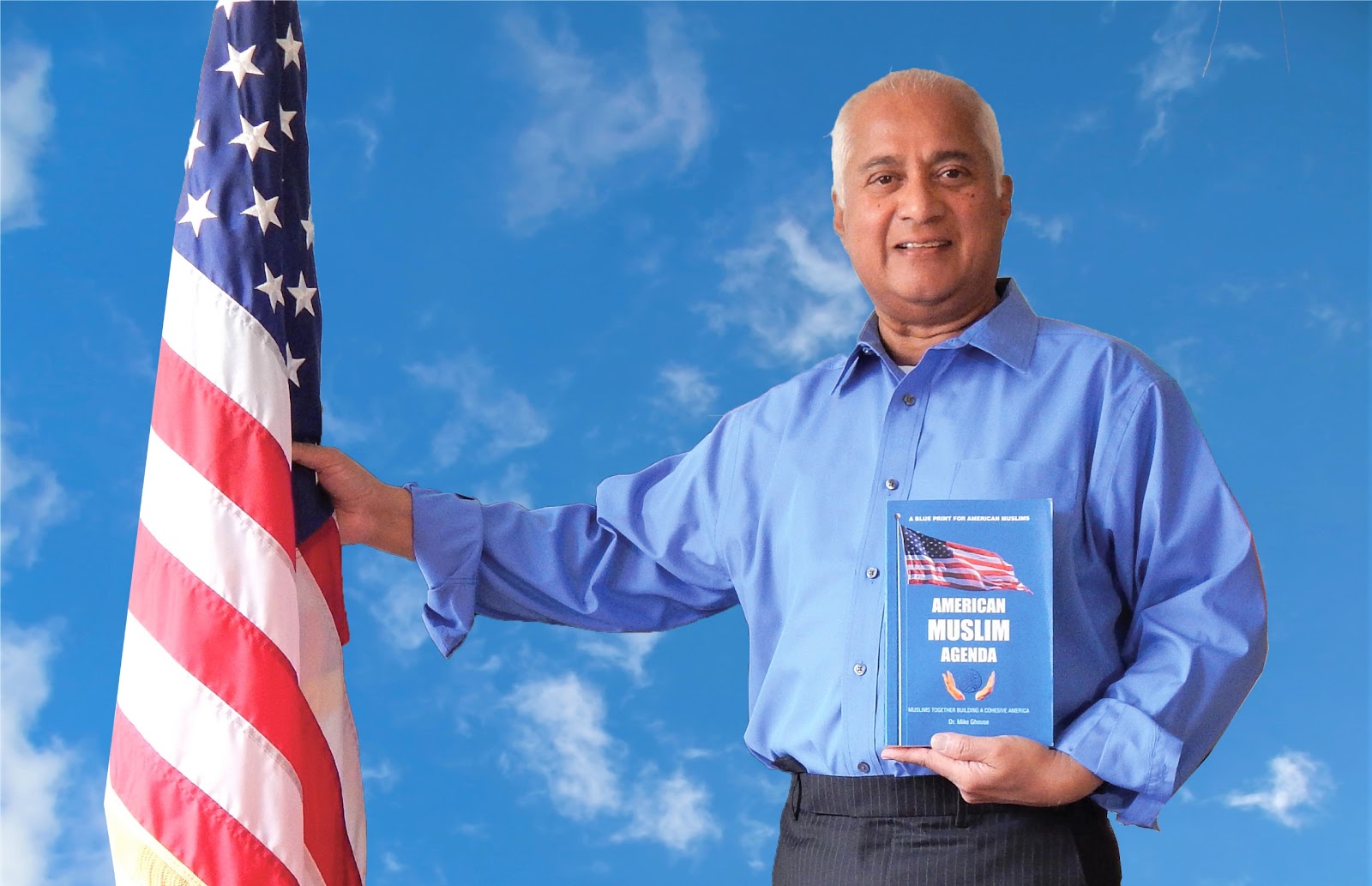
Mike Ghouse is committed to building cohesive societies and offers pluralistic solutions on issues of the day. His book, the “American Muslim Agenda” is about Muslim earning their respectable space in the society. The book is available at Amazon, Xlibris, Google, Barnes and Noble, and Kindle. Mike’s mission is to open people’s hearts, minds, and souls towards each other. He believes that the ultimate purpose of humans is to live freely and be comfortable with their culture, race, religion, ethnicity, sexuality, and individuality. Mike is a public speaker, author, interfaith wedding officiant, a newsmaker and the executive director of the Center for Pluralism in Washington, DC. More about him in three formats at https://www.linkedin.com/in/mikeghouse/

Thursday, April 25, 2019

Book About Muslims - American Muslim Agenda

If you are a conservative, then grudgingly you'll see the value in what this book offers, and if you are on the left, you want more of it, and if you are moderate, you will dance with joy.

HOSTING A BOOK TALK


The book is about building a cohesive America where each one of us feels secure about our faith, race, ethnicity, culture, sexual and political orientation. Who does not want to live a tension free life at home, workplace, and in the public space? 

The "American Muslim Agenda” serves a two-fold purpose. On the one hand, it separates the chaff from the grain for fellow Americans to see Muslims for who they are and not how the media projects them. On the other hand, it challenges Muslims to restore Islam to its original purpose; that is to create cohesive societies, in our case, a coherent America, where each one of the 323 Million Americans feels proud of his or her uniqueness. 

The book presents many success stories to keep the reader bemused. I am pleased to submit three versions of the blurbs on the book talk. The format can be 10 minutes or 20 minutes presentation with room for Q&A. We want our esteemed guests to go home fully satisfied with all the questions they have had about Islam and Muslims. 

Our conservative friends would grudgingly acknowledge the pathway laid out in the book, while the moderates will dance with joy. If your vision of America is in tune with the book, together as Americans, we can contribute towards the greatness of our nation.


Would this book bring a change? 


Would this bring a change among Muslims towards others and others towards Muslims? Indeed, this book lays out a clear agenda to foster harmony among fellow Americans. It is akin to planting a seed and nurturing to give the beneficence to the next generation.

Some of the reservations we have about Muslims is based on what we have heard from our parents, friends, teachers, pastors, and TV. It is time for us to learn first-hand about them and remove the misunderstandings and live freely. 

It is one of the bold books written about Muslims, and it highlights the sources of extremism and how to cure it.

Unfortunately, some of the Muslim scholars from the past have reduced Islam to a religion of rituals and obedience. This book brings clarity to Muslims and fellow humans and separates the chaff from the wheat for you.

What is the overall theme of your book?


The overall theme of the book is to open people's hearts and minds towards each other. I believe that the ultimate ‘unexpressed’ purpose of humans is to live freely and be comfortable with one's culture, race, religion, ethnicity, sexuality, and individuality.

Why do you think that this book will appeal to readers?

It will appeal to Muslims and Non-Muslims alike, as they have never seen the pristine, pluralistic Islam. Moreover, for the first time in Islamic history, the essence of Islam is explained. Also, for the first time, the book explains twelve values directly from the Quran that contributes towards building cohesive societies with no privileges to one over the other. It is human nature to get along with fellow beings, and this book will resonate with them and pave the path for them to see the light at the end of the tunnel.


TEN TAKE AWAY POINTS FROM THE BOOK

1. The American Muslim Agenda challenges Muslims to think and restore Islam to its original purpose – i.e., to create a cohesive America, where each one of the 323 Million Americans feels secure with his or her faith, race, ethnicity culture, sexual and political orientation. 


2. The American Muslim Agenda paves the way for Muslims to own their mistakes, and remedy them. It corrects how fellow Americans perceive Muslims.


3. Islam is not about imposing (Sharia) your ideas or governing others. Islam is about living your life and letting others live theirs with freedom. That is the original Islam. Islam is about freedom and firmly stands for free will.

4. The essence and purpose of Islam from a humanity’s (Aalameen) perspective for the first time.

5. Never before in Islamic history, twelve values of Islam that contribute to creating secure, orderly and cohesive societies have been articulated. Verses from the Quran fully back each value. Thus, the book becomes a reference manual to teach and learn about Islam.

6. The best way to combat Islamophobia is through education, engagement, and dialogue. There are many success stories narrated including dealing with Fox News, Sean Hannity, Stuart Varney and the supposedly most of the Islamaphobes.

7. This book is the product of twenty years of research and interviews with the right, left, and the moderate fellow humans from many faiths including 150 interviews at Fox News and its many right-leaning guests.

8. Can a Muslim become President of the United States? What does it take, there is a full chapter on the topic?

9. In the end, it is learning to respect the otherness of the other and accepting the God given the uniqueness of each one of the 323 million Americans.

10. There is a whole lot more, and it is all in the book.

Talk Version 1.0

Title of the talk: Muslims making America the Greatest nation on earth.

Americans Muslims are committed to building a cohesive America, an inclusive America where each one of the 323 Million Americans feel secure about his/her faith, race, ethnicity, culture, sexual and political orientation.

When you are free from apprehensions, and connect with fellow workers, the workplace becomes a joy to be. You will give 100% of your heart and mind to your work, and your family benefits from having a whole of you, thus creating a little heaven for yourselves.

Dr. Mike Ghouse, author, public speaker, pluralist, interfaith wedding officiant, and the president of the Center for Pluralism in Washington, DC., will discuss how Muslim efforts in building a cohesive America are working.

He points out that we are Americans, we are free and brave people and must jettison our apprehensions about each other to live freely. Mike advises that if you are a conservative, then grudgingly you'll see a value in what this book offers, and if you are on the left, you want more of it, and the moderates will dance with joy.

He points out that we are Americans, we are free, and the brave people, and must jettison our apprehensions about each other to live freely. How do we accomplish that? It is by knowing each other.

America has always led the world in science, medicine, math, agriculture, automation, information technology, exploration and all the advancements of the human race, and it is time for us to lead the world in building a cohesive nation. The book offers concrete solutions to Americans to make America a great and powerful model nation of inclusion for Americans to enjoy living their lives productively and purposefully, and the world to look up to us to emulate.

We have to assure each other and every American without exception that we are committed to each other's security, prosperity, and peace. Our goal is to reach out to every American who has not been reached before, particularly those who do not understand us. As American Muslims, we uphold, protect, defend and celebrate the values enshrined in our constitution.

Mike will share a few incredible success stories of dealing with our friends on the right and answer questions about Muslim efforts.

The book “American Muslim Agenda” will become a reference manual to knowledge seekers and teachers of Islam, and those who want to see one nation, one people and one America. For Muslims, it is backed up with verses from the Quran. You can order this book from Amazon, Kindle, Barnes & Noble, Google, and other book stores. See the talking points at http://www.AmericanMuslimAgenda.com and Mike’s profile appended at https://www.linkedin.com/inmikeghouse.

Talk Version 2:0

Title of the talk: Muslims making America the Greatest nation on earth
Americans Muslims are committed to building a cohesive America, an inclusive America where each one of the 323 Million Americans feel secure about his/her faith, race, ethnicity, culture, sexual and political orientation.

When you are free from apprehensions, and connect with fellow workers, the workplace becomes a joy to be. You will give 100% of your heart and mind to your work, and your family benefits from having a whole of you with them creating a little heaven for yourselves.

Dr. Mike Ghouse, author, public speaker, pluralist, interfaith wedding officiant, and the President of the Center for Pluralism in Washington, DC., will discuss how Muslim effort is ongoing in building a cohesive America, where each one of the 323 Million Americans feel secure about his/her faith, race, ethnicity, culture, sexual and political orientations.

He points out that we are Americans, we are free and brave people and must jettison our apprehensions about each other to live freely. Mike advises that if you are a conservative, then grudgingly you'll see a value in what this book offers, and if you are on the left, you want more of it, and the moderates will dance with joy.

The book paves the way for Muslims to own their mistakes, remedy them, and correct how fellow Americans perceive Muslims. Mike argues that Islam is not about imposing your ideas or governing others. Instead, Islam is about living your life and letting others live theirs with freedom. It is a bold challenge to Muslims. He shows a narration from humanity's (Aalameen) perspective of the essence and purpose of Islam for the first time in history.

Mike articulates, for the first time in Islamic history, twelve values of Islam that contribute to creating secure, orderly and cohesive societies. He concludes that the best way to combat Islamophobia (and other phobias) is through education, engagement, and dialogue. Mike lays out a clear agenda to foster harmony among fellow Americans. It is akin to planting a seed and nurturing to give the beneficence to the next generation.

Mike believes when Muslims become one with all and defend American values with their souls, they will become part of the American story, and everyone’s language will automatically shift from us vs. them to us, the one nation under God with liberty and justice for all. As American Muslims, we uphold, protect, defend and celebrate the values enshrined in our constitution.

This book will become a reference manual to teachers of Islam and knowledge seekers about Islam, as it is backed up verses from the Quran. You can order his book from Amazon, Kindle, Barnes & Noble, Google, and other book stores. See the talking points at http://www.AmericanMuslimAgenda.com and Mike’s profile appended at https://www.linkedin.com/inmikeghouse.

BOOK - Version 3.0

The American Muslim Agenda is a primer, a blueprint, and a road map for Americans in general and Muslims in particular.

A Muslim is someone who is a conflict mitigater and a goodwill nurturer, following the formula for peaceful societies practiced by Prophet Muhammad (PBUH) and guided by the Quran.

As a community, American Muslims have not developed any concrete plans to extricate themselves out of the chaotic situations, hostility and incessant Islamophobic rhetoric we face. Each time a terrorist acts out, we start praying and wishing that the terrorist not be a Muslim. We are Americans, and we can do better than that.

There is only one America, and all of us are fully integrated parts of that nation. We need to learn to engage with those who are opposed to us, and reassure them that we are all in this together. Mike will share some success stories.

When we start defending America and the American values we are in! We become an integral part of American Fabric. That is the clear objective articulated in this book.
The book is available at Amazon, Kindle, Google, Xlibris, Barnes & Nobles, and other book stores. The softcover is priced at $19.99, and the hardcover is $29.99. It is also available as an eBook.

The American Muslim Agenda will be in the hands of lawmakers, presidential candidates, media persons, lobbyists, think tanks, educators, interfaith activists, CEO, and fellow Americans. The book is about building a cohesive America where each one of us can live securely with our faith, race, ethnicity, and culture.

As American Muslims, we uphold, protect, defend and celebrate the values enshrined in our constitution.

Mike is a public speaker, author, interfaith wedding officiant, a newsmaker and the executive director of the Center for Pluralism in Washington, DC. More about him at https://www.linkedin.com/in/mikeghouse/

Email to: SpeakerMikeGhouse@gmail.com or text (214) 325-1916

Tuesday, April 23, 2019

Will BJP turn India upside down?

6 Things That May Happen If The BJP Comes Back to Power

If we thought the last five years were bad, we haven’t seen anything yet.

The possibility of the Bharatiya Janata Party (BJP) retaining power following the Lok Sabha election is legitimately frightening for a large section of India’s population as the last five years have seen, among other things, a rise in violence against Muslims and Dalits, crackdown on dissent and civil liberties, high unemploymentpoor economic growth and anti-farmer and anti-worker policies.
To add to these fears, BJP leaders have been dropping hints about the saffron party’s plans on what the next years may look like for the Indian democracy. Based on it, here is a list of 5 things that are likely to happen if the party comes back to power.
1. No more elections, obviously. 
Don’t say BJP MP from Unnao Sakshi Maharaj didn’t warn us. While addressing a gathering of party workers last month, he proudly proclaimed that 2019 election would be the last election of the Indian democracy if Prime Minister Modi wins.
According to the saffron-clad so-called monk, there is an awakening in the country and that “Hindu jag gaya hai (Hindus have awaken)”. He added, “After this (2019) election, there will not be an election in 2024.”
Before you disregard his words as ramblings of a ‘motormouth’, remember that party president Amit Shah had also said that the BJP would be in power for the next 50 years. “We have not come to power for 5-10 years, but at least 50 years. We should move forward with a conviction that in 40-50 years we have to bring major changes in the country through the medium of power,” he had said.
2. Goodbye to the Constitution of India (as you know it), you had a good run
Pankaja Munde, a BJP minister in Maharashtra and the party’s Lok Sabha candidate from Beed, said while addressing a poll rally this week, “This is not a Zilla Parishad, but a Lok Sabha election. Mahamanav Dr. Babasaheb Ambedkar wrote the Constitution. We have to change the Constitution, bring new Bills and make some changes.”
constitution of India(Photo: Wikimedia Commons)
If anyone has doubts about what kind of changes she might be referring to, remember that the BJP’s ideological mothership, the Rashtriya Swayamsevak Sangh, wants India to be a ‘Hindu rashtra’. This blatant disregard for constitutional values finds a friend in BJP’s loud proclamations of Hindu nationalism.
Union Minister for Skill Development Ananth Kumar Hegde has also hinted at dropping the word ‘secular’  from the constitution, “Some people say the Constitution says secular and you must accept it. We will respect the Constitution, but the Constitution has changed several times and it will change in the future too. We are here to change the Constitution and we’ll change it.”
3. Demonetisation Redux
PM Modi demonetised Rs 500 and 1000 notes on November 8, 2016, and the Indian public forced to stand for long hours outside banks and ATMs was the least terrible consequence of it. Reports have suggested that the policy destroyed India’s informal economy, put millions out of a job and resulted in the death of around 100 people.
demonetisationPeople waiting in queue to exchange the demonetised notes
The decision was taken even though the RBI had expressly said that it would do nothing to eradicate black money. And it didn’t since 99.3% of the demonetised notes entered the banking system.
However, the government refuses to acknowledge that the policy has been a failure. There have been allegations that after demonetisation, BJP chief Amit Shah oversaw a large money laundering racket involving top government officials, where black money was exchanged for a commission.
What exactly was the purpose of demonetisation? No one really knows. Earlier this month, Union Minister Suresh Prabhu reiterated that the measure was taken to eradicate black money. “This (demonetisation) was one measure aimed at taking care of black money. I am not going to tell you whether we need one more (round of it),” he said.
If the BJP does implement the policy again, it will come as a shock but not as a surprise.
4. Say hello to legalised child marriage
The ruling party has time and again expressed their desire to restore the worst practices of the Indian society.
BJP leader Gopal Parmar, who was an MLA in Madhya Pradesh before the 2018 assembly election, had referred to the law against child marriage as the ‘18-year disease‘ that causes ‘love jihad’, because the agency and health of young girls can be sacrificed for bigotry.
“Earlier, the elders of the family used to fix marriages in the childhood, and those relations used to last longer,” the erstwhile BJP MLA had said, adding that “Since the government started this ‘18-year disease’, many girls have started eloping as the fever of love jihad has gripped them.”
While he may no longer be a lawmaker, there is another BJP MLA who was elected to office after she promised that she will not let the police take action against child marriages.
While campaigning in Rajasthan’s Pali, now BJP MLA Shobha Chauhan had said, “In your area, when younger girls are getting married, the police arrives. It is very fortunate for all of you that both political and organisational power is with us. If it is at my level, I will take care of it and if it is at the level above mine, then I will get it done from those above me. Hereon, if there is a such an event (child marriage), the police won’t come to your house. I promise this to you.”
Chauhan may have won from the Pali seat but girls and women lost.
5. Dividing citizens into separate classes
One of the amazing thing about the Indian constitution is that it promises us the right to equality irrespective of gender, language, caste and religion. The state is not allowed to discriminate among the citizens based on any such differences. However, it appears that the BJP is not really a fan of this feature.
Union Minister Maneka Gandhi, addressing a rally in Pilibhit, told people —Muslims— that she is going to win this election, with or without their votes. She carefully added that in the event that they do not vote for her, she will not give them jobs (lol because everyone else got so many jobs under the Modi govt) and will not work for her.
Maneka GandhiUnion Minister Maneka Gandhi (Photo: Facebook)
In another rally, she further told people, in detail,  how villages will be categorisedaccording to the share of people that voted for the BJP. ‘A’ grade for villages from where 80% of the votes are cast for the BJP; B category villages where 60% of the vote share goes to the BJP; C category for villages where 50% votes go to the BJP; and D category for the rest.
Moreover, she said that development work in these villages will be prioritised in A villages, followed by B,C and D respectively.
6. Ethnic cleansing (or genocide)
This is not a bogeyman. The BJP government at the centre brought in the Citizenship (Amendment) Bill, 2016 that is prima facie discriminatory against Muslims and other religions. It seeks to provide citizenship to  “illegal migrants” from Afghanistan, Bangladesh and Pakistan, who are of Hindu, Sikh, Buddhist, Jain, Parsi or Christian extraction only. The bill, thankfully, did not pass in the Rajya Sabha. Right now, the definition of “illegal migrants” in the Citizenship Act, 1955 does not discriminate against Muslims.
The implementation of the National Register of Citizens (NRC) in Assam, as it has been pointed out, inherently discriminates against linguistic, religious and ethnic minorities. Around 40 lakh people were left out of the first NRC draft, many of whom have lived in Assam for generations but don’t have official documents dating back to 1971 to prove their citizenship.
Amit Shah has referred to these people —mostly ethnic, religious and linguistic minorities — as ‘infiltrators’ and ‘termites’, following in the footsteps of one Adolf Hitler who referred to Jewish people as ‘cockroaches’ before he went ahead and killed at least 6 million jews and launched a war that killed many more people.
Recently, Amit Shah said that after coming back to power, they will implement NRC in the entire country. to remove “every single infiltrator” except Buddhas, Hindus and Sikhs.