HOME | ABOUT US | Speaker | Americans Together | Videos | www.CenterforPluralism.com | Please note that the blog posts include my own articles plus selected articles critical to India's cohesive functioning. My articles are exclusively published at www.TheGhouseDiary.com You can send an email to: MikeGhouseforIndia@gmail.com


Thursday, May 8, 2014

Everything you wanted to know about Indian elections but were afraid to ask

Everything you wanted to know about Indian elections but were afraid to ask
 

http://rt.com/op-edge/157104-facts-about-elections-in-india/


Rajeev Sharma is a New Delhi-based journalist, author and strategic analyst. He tweets @Kishkindha and can be reached at bhootnath004@yahoo.com.

Published time: May 06, 2014 13:16
Polling officials check electronic voting machines in a truck after collection them at a distribution centre in the northern Indian city of Allahabad May 6, 2014 (Reuters / Jitendra Prakash)

T
he story of colorful and chaotic elections in India, the world’s largest democracy, can offer many surprising vignettes.

Did you know that a record number of 1,033 candidates contested the Modaurichi assembly constituency in Tamil Nadu in 1996, and the ballot paper was in the form of a booklet?
Or that the lowest voter turnout in a polling station is just three, reported from Bomdila district in Arunachal Pradesh?

Or that in Gujarat's Gir Forest, officials set up a voting booth, manned by five people for just one voter, Mahant Bharatdas?

The ongoing general elections in India, set to become the biggest election in world history, are nothing short of a marvel too, not just in terms of sheer size and numbers but also when one considers weird facts and practices associated with the grandest spectacle on earth.

A whopping number of 814 million voters are eligible to vote in the nine-phase, five-week-long polling process (April 7 – May 12), 103 million more than the population of the whole of Europe.

There are over 100 million first-time voters eligible to vote in these elections, more than the size of populations of UK (63.7 million) and Canada (34.8 million) put together. Of these, 23 million first time voters are from Uttar Pradesh alone, just 3 million less than the population of the five Nordic countries (Denmark, Finland, Iceland, Norway and Sweden) put together.

To make this possible, the Election Commission of India has made arrangements for nearly a million polling stations, an increase of nearly 12 percent since last general elections in 2009. So many polling stations were necessary, considering the Election Commission’s decision that no one should have to travel more than two kilometers to reach a polling station, and that no polling station should have to manage more than 1,500 voters.

Ten million people will be directly involved in conducting the elections in 543 Lok Sabha constituencies. By the time the Indian general elections are over and the results announced on May 16, over 200,000 security personnel would have been deployed to ensure peaceful conduct of elections and more than 100 trains, thousands of buses and more than a dozen helicopters would have been used for ferrying the security personnel.

India’s elections will cost about $5 billion, 150 percent more than the last elections in 2009, according to New Delhi-based think tank the Centre for Media Studies. Of this amount, about $1.3 billion is expected to be spent by the state exchequer. The total costs may go up and may even rival the $7 billion spent by candidates and parties in the last presidential elections in the United States in 2012.

Polling officials demonstrate to residents how to use an electronic voting machine during an awareness program at a red-light area in Kolkata May 6, 2014 (Reuters)

Strange but true

- A total of 3.26 million Electronic Voting Machines will have been used once the ninth and last polling phase is completed on May 12. Indigenous EVMs were first used in Kerala. The highest number of candidates that an electronic voting machine can support is 64. If there are more candidates, then a manual ballot is used.

- India’s first general election in 1952 was spread over two months. Different colored ballot boxes were used for each candidate, rather than voting on ballot paper!

- The highest voting percentage in any general elections has been 62.2 percent in 1957. The lowest was in 1967, when only 33 percent cast their vote. In the last general elections in 1999, 59.99 percent cast their votes.

- Of all the 28 Indian states and seven union territories, it is Lakshadweep, not Jammu and Kashmir, which has the largest presence of Muslims.

- The Bharatiya Janata Party (BJP) won Lok Sabha seats for the first time in the states of Tamil Nadu and West Bengal in 1998.

- Atal Bihari Vajpayee is the only parliamentarian to be elected from four different states – UP, Gujarat, MP and Delhi. Vajpayee is the only politician who has won from six different constituencies: Balrampur – 1957, 1967, Gwalior – 1971, New Delhi – 1977, 1980, Vidisha – 1991, Gandhinagar – 1996, Lucknow – 1991, 1996, 1998.

- Mayawati`s Bahujan Samaj Party (BSP) and the United States’ Republican Party both have the same electoral symbol – the elephant.

- Chhindwara in Madhya Pradesh is the only constituency in the Hindi belt which has always returned Congress during the general elections.

- Rajnandgaon in Madhya Pradesh has a unique feature – father, mother and son have represented this constituency at different times.

- The word candidate comes from the Latin “candidatus” meaning “one clad in white.” Incidentally, white is the most preferred color of Indian politicians, cutting across party lines.

- “Ballot” and “bullet” are both derived from words for “balls.” The Greeks dropped a white ball when they favored a candidate and a black when they were against.

Polling officials carry electronic voting machines in an alley to demonstrate to residents how to use the machines during an awareness program at a red-light area in Kolkata May 6, 2014 (Reuters)

Firsts in the 2014 Indian elections

- For the first time voters across the country would be able to exercise the “none of the above” option for candidates in the 2014 polls. India is the 12th country to implement NOTA.
- Over 28,000 transgender community members have registered in the electoral poll so far and will be eligible to vote in this election. Election Commission has introduced this category in 2012. India's transgender community is being recognized for the first time and can vote under “third sex” or “others,” a category that didn't exist in the previous elections.

- Around 12,000 non-resident Indians registered as voters will be able to exercise their voting rights for the very first time. Kerala has the highest number of NRI voters. A citizen-reporting tool called Election Watch Reporter, an Android-based application developed by the National Election Watch, is being deployed by the Election Commission in the polls to keep a check on malpractices such as bribing of voters in the form of liquor distribution, cash and also excessive spending by candidates. This tool will enable citizens to capture photographic evidence with an accurate GPS location and the time of any offense in and around elections and report it instantaneously to the nearest election commission observers.

- By the time voting is over, BJP will have targeted as many as 150 million voters via-e-mail and SMS, a record of sorts – indicating the rapidly changing face of campaigning in Indian elections.


The statements, views and opinions expressed in this column are solely those of the author and do not necessarily represent those of RT.

Wednesday, May 7, 2014

Little Men - Chote Pursh Mohan Bhagwat

Most of the misogynist statements come from the followers of RSS, Talibans, Tea Party Men, Right wing Christians, belligerent Buddhists and Right wing Muslims; they are all feathers of the same flock even though they wear different religions; Insecure intolerant men who want slavish obedience.  
Mr. Bhagwat, the RSS Chief  is saying exact same words as some of the Mullahs speak about Sharia. The First paragraphs is what a Mulla says word for word.  'Women meant to do household chores': another shocker from RSS chief

Mike

# # #
'Women meant to do household chores': another shocker from RSS chief
 
Indore:  A day after he sparked a controversy by saying that rapes happen in India not Bharat, right-wing Rashtriya Swayamsevak Sangh's (RSS) chief Mohan Bhagwat has done it again. Now, he says women should restrict themselves to doing household chores, according to what he calls the theory of social contract.

"Theory of contract, theory of social contract, a husband and wife are bound by a contract which says 'you (woman) look after the household chores and satisfy me, I (man) will take care of your needs and will protect you', and until she delivers her duties without fail, he keeps her on the contract and if she fails to honour the contract, he disowns her and if it is the same with the husband who is not honouring the contract, she can also abandon him and go for a new contract then," he said yesterday, while addressing a gathering of RSS workers in Indore, Madhya Pradesh.

Reacting sharply to Mr Bhagwat's comment, CPI(M) leader Brinda Karat said, "I don' think it is really surprising because at the end of the day, this is what RSS is. That is why I think it is the retrograde 'samiti' of India. These were the regents who when BJP was in power wanted a new Constitution of India based on 'manusmriti'. So when he talks in this language, he only reflects his ideology."

The RSS, though, defended Mr Bhagwat's remarks, saying the projection of his views on the marriage system in the Indian context is "totally false".

"It is totally falsifying his views. He said the western marriage system is contractual where a man and a woman consider marriage as a contract whereas he also went on to say that Indian marriage system is a very sacred institution.

"In this, the woman has a place of great respect and the man has certain obligations towards the family and the way the whole thing was projected was as though Bhagwat was calling Indian marriage contractual. This is total distortion of what he has said," RSS spokesperson Ram Madhav said.

On Friday, speaking at a gathering of RSS workers in Silchar in Assam, Mr Bhagwat had said that rapes are an urban crime shaped by westernisation, and are not a matter of concern in rural India where traditional values are upheld. "Crimes against women happening in urban India are shameful. It is a dangerous trend. But such crimes won't happen in Bharat or the rural areas of the country. You go to villages and forests of the country and there will be no such incidents of gang-rape or sex crimes," he had said.

"Where Bharat becomes 'India' with the influence of western culture, these type of incidents happen. The actual Indian values and culture should be established at every stratum of society where women are treated as 'mother'," he had added.

The RSS is the ideological mentor of the main opposition party, the BJP. Mr Bhagwat's remarks were shredded by activists and other political parties, but the BJP offered no criticism.

Describing the controversy as "uncalled for", the party's spokesperson had said that Mr Bhagwat "was referring to India's sanskar, tradition and value system where respect for women occupies a pride of place."

Mr Bhagwat's comments come at a time when the death of a young medical student, who was gang-raped in Delhi, has impelled introspection on attitudes towards women in a country where a rape is reported nearly every 20 minutes.

(With inputs from PTI)


Sunday, May 4, 2014

Ground Breaking Ceremony of Mahatma Gandhi Memorial Plaza in Thomas Jefferson Park, Irving, Texas.

URL - http://theghousediary.blogspot.com/2014/05/ground-breaking-ceremony-ofmahatma.html
The Ground Breaking Ceremony of ”Mahatma Gandhi Memorial Plaza" in Thomas Jefferson Park, Irving happened today, Saturday, May 3, 2014 in Irving  (Caveat - please read my note at the end of this write up).

Hon. Nikki Haley, Governor South Carolina, Hon. Beth Van Duyne, Mayor of Irving City, and India’s consular General from Houston, Hon.
Mr. Parvathaneni Harish and many other dignitaries including Dallas’s two Padmashri’s (India’s civilian Medal of Honor) Dr. Venkat Ram, Ashok Mago and the India's who is who  attended the ceremonies.

The 7’ Bronze statue was cast in Andhra Pradesh, India and will be installed by October 2, 2014 on a 6’ platform, and a granite wall in the back will be adorned with inscriptions from Gandhi’s saying and the quotes from Dr. Martin Luther King Jr., Nelson Mandela and Einstein. The cost of approximately $250,000 is borne entirely by the community and not a dime will come from the public funds.
However, you can  donate generously.

Nothing ever happens in the world without the drive of an individual and his or her supporters. For the last four years, Dr. Prasad Thotakura, Tayyab Kundawala and Dr. Rao have been working hard to have an iconic representation of Mahatma Gandhi in Dallas. There are many others who are involved in it in so many ways,  but these are the faces of the organization that I have seen.


It was not an easy task, but finally they got the former Mayor of Irving Mr. Herbert Gears to agree to place the statue in the heart of the Thomas Jefferson Park, and the new Mayor of Irving Beth Van Duyne affirmed her support a few years ago.

The event was graced by her Excellency Gov. Nikki Randhawa Haley. She is the first woman governor of South Carolina, youngest governor in the United States, and the first Indian American female Governor, and Bobby Jindal is the first Indian American male Governor.  As Shabnam Modgil, Dallas' face of India said, "she is the most beautiful Governor".

The Governor said, “ that there is no reason we cannot have peace and love with everyone, and one thing he constantly said was if we want to truly have peace and love, we have to start with Children.  By putting this statue in a park, we are starting out with children, reminding them who he was, reminding them what he was about, and reminding them of the celebration he wanted his life to live on. He said be what you want.

She then turned to Prasad Thotakura and said, " Prasad, there is nothing you could not do.” Indeed, that is the truth.

She continued, “when I look at the statue, I see a man of the peace. To walk in the state house of South Carolina as a first India American woman as Governor, I hoped that's exactly what he wanted for all communities, for all people, and for all minorities to be able to be free as they wanted to be, as peaceful as they wanted to be, and to get to contribute to the world, and that is what we are celebrating today.

She said, "Indian American community is the least dependent community on receiving aid from the state, and most educated communities in America."

Nikki Haley must be a moderate Republican like me, even though she is billed as a conservative Republican.  She sounds like Obama with inclusiveness, a trait missing among the conservative Republicans and acutely deficit with regular Republicans.

Later in the evening I mentioned to her that Sean Hannity is a great fan of hers, and we have talked about her - as fellow Indian Americans. She was excited to hear about the message of my upcoming book, standing up for others and wants to read it.

At the dinner she mentioned about skills data collection from recipients of unemployment benefits, and matched it with employers that could use those skills and thus  removed several thousand from the welfare to income ( I forgot the number). Then she said something interesting that is unlike Republicans - These men and women want to work rather than receive the benefits, wow Nikki! Glad to hear the affirmation that she is a moderate Republican and I can relate with her.  I did mention to her earlier that I was glad she was speaking like a moderate,  rather than a conservative Republican.

Mayor Beth Van Duyne appreciated the community for funding it entirely on their own and she asserted that zip code 75038 had the most diverse population in America.

I must also mention the role of John Hammond and Shabnam Modgil of FunAsia in the affairs of desi community.  It was my dream a long time ago, like the dream of many of you here in Dallas that there should be an energy that brings people together, and facilitates knowing each other. Thanks to John, his Radio is a major catalyst in Dallas to bring the Desi communities together.

Funds are needed to complete this project by October 2nd. , please  donate generously, and be a part of the future. If you donate over $5000, your name or your parents name will written on the granite wall. 

 
Remembering Mahatma Gandhi

This statue symbolizes the work of Mahatma Gandhi, who believed in resolving conflicts through non-violence.  I hope this statue does not remain a symbol, but an inspiration to all of us – to think, talk and act like him.

As a pluralist, I often think how he would handle a given conflict, up0n reflections pat comes the answer – no bias towards the other and justice to all.  He once said, a good Hindu is a good Muslim, a Good Muslim is a good Christian and a Jew… and so on.

Gandhi is an example of what a Hindu ought to be.  He believed in many of the guiding principles of what is known as Hinduism – of them I will mention two here;

The highest ideal of a Hindu (or any one) is to become Brahma – i.e., become one with  energy of the Universe also known as God – when you become Brahma , then there is no distinction between you and another human being, you and the mountain – this all become part of you, and you become part of the  whole.

No more will you consider another human to be anything less than you or greater than you, but another spoke in the wheel of life.

The second principle he really believed in was the wisdom of our pluralistic ethos embedded in the Sanskrit phrase Vasudhaiva Kutumbukum, a concept where everyone is considered to be a part of one big human family and hence must take care of each other.  If one is hurt, you feel the hurt, if one is happy you feel the happy – thus creating a cohesive world where no one has to be afraid of the other.

This is also the Islamic concept, where God says we are all made from the same couple into many tribes, communities and nations and enjoins us to know each other to create harmony and cohesiveness.

The third principle is that of non-violence.  When God created animals and humans, he programmed them how to handle conflicts between any two.

For instance, when two goats or tigers are fighting for food or a loved one, God has given them horns or fangs to settle the dispute, the mighty gets it.  In Hindi and Urdu there is a saying Jis ki laathi us ki bhains.

However, look at the non-violence built into us that we forget often, and Gandhi invoked it all the times.  God did not give us horns or fangs or paws to tear each other apart in a conflict – instead he gave us a tongue – to dialogue and resolve the issues.  That is non-violence method of resolving disputes.

I hope this statue reminds us how to deal with each other, particularly during this election season. We have a tongue to dialogue without tearing each other.

I hope every time, and every day, if we feel biased, hatred, or angered towards another human being,  think of this great man – the great soul, Mahatma Gandhi and find inspiration to seek freedom from the shackles of bias. 

Mahatma Gandhi’s soul would be smiling at the people gathered in the park today. He lived and sacrificed his life for the unity of people of the Subcontinent.  As the balloons were released into the bright sunny blue skies, I was imagining the smiling affectionate face of Mahatma Gandhi – seeing the Pakistani community members joining hands with the Indians to get the memorial built as a reminder of unity. Indeed it is a great accomplishment for the people of Dallas. 

I hope this statue beams the energy of positive living, learning to respect the otherness of others and accepting the God given uniqueness of each one of us.

Peace be upon all the peacemakers!

----
PLEASE NOTE:

1. This my personal note as a member of the community and not an official note of the organization. the information I have added is from what I have heard from the podium. For the full official version go to http://www.iafcusa.org/ and  http://mgmnt.org

2. There were many people involved in this, and all of that will be in their official record.  When this gets published, it will be reduced to 1200 words, but here on my blog www.TheGhouseDiary.com and http://MikeGhouseforIndia.blogspot.com will remain in full size.

3. I am not a paid to paid to write, nor do I write for any organization on a paid basis, when I attend an event, I usually write a short to long note depending on the availability of time. when I see something good, I write and I have written over 2500 pieces in the last 30 years, none were paid even though most of them were published including a bulk  in Dallas Morning News (over 160), Huffington Post (nearly 100) and news papers and magazines around the world. I encourage you to write, to get all perspectives in.  Most of them are at www.TheGhousediary.com. 

 PICTURES - https://www.flickr.com/photos/mikeghouse/sets/72157644499431684/

These pictures were taken by me personally, and I wish I had ten hands and ten cameras to capture every one who attended,  but no one can do that except the paid photographer, in this case Bombay Photography.  I will add the link later where you can see almost all the pictures where every one who attended (impossible) will be in the pictures.  

I am a proud life member of India Association of North Texas, and I urge you to become one by reaching out to any one at: www.iant.org

THE DRESS CODE

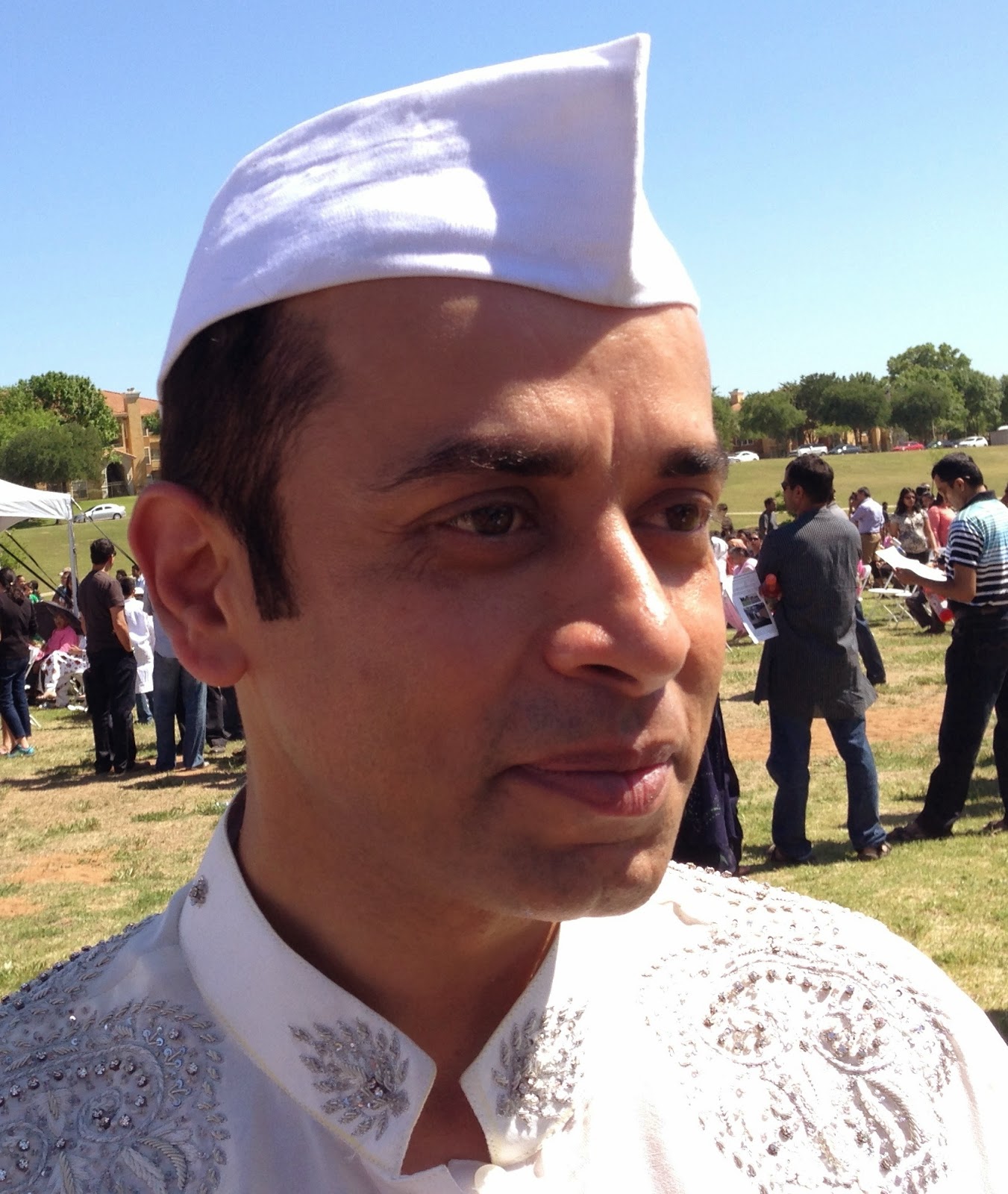
I could not resist watching the caps on the ground, I made a mistake by not wearing one myself, God willing I will dress up and urge all to do the same on October 2, 2014 when the Stautue of Gandhi will be unveiled.  The best fitting topi award should go to John Hammond, and the runner ups were Kuntesh Chokshi and Jack Godhwani. I meant it looked good on them. If you differ, propose the names as I have not seen all of them.  Look at John's picture and Pandit Jawahar Lal’s topi - well creased - the perfect topi.  


Among the founding fathers of the nation, Mahatma Gandhi did not wear the cap in the last years of his life, even though he did at the beginning.  Maulana Abul Kalam Azad had his own cap, Sardar Patel probably did not wear the cap and neither Dr. Ambedkar (correct me if I am wrong). Anna Hazare made it popular again and Arvind Kejriwal has made it his trade mark now.


Jai Hind


...............................................................................................................................
Mike Ghouse is a speaker, thinker and a writer on pluralism
, politics, peace, Islam, Israel, India, interfaith, and cohesion at work place. He is committed to building a Cohesive America and offers pluralistic solutions on issues of the day at www.TheGhousediary.com. He believes in Standing up for others and a book with the same title is coming up. Mike has a strong presence on national and local TV, Radio and Print Media. He is a frequent guest on Sean Hannity show on Fox TV, and a commentator on national radio networks, he contributes weekly to the Texas Faith Column at Dallas Morning News; fortnightly at Huffington post; and several other periodicals across the world. His personal site www.MikeGhouse.net indexes all his work through many links.

Saturday, May 3, 2014

The real reason Indian intellectuals are backing Narendra Modi

A few good paragraphs worthy of studies.

"In India itself, there are still strong holdouts resistant to the attractions of the BJP, though some of those who had staunchly opposed the BJP in the past are now toning down their criticism. Shekhar Gupta, editor of the liberal Indian Express—one of numerous newspapers that excoriated Modi during the 2002 riots—wrote in a recent column mockingly titled “Secularism is dead!”: “This anti-Modi battle cry is lazy, illiberal and an affront to Muslims—and Hindus.” But he makes two strong points.

One, the BJP-led alliance would get no more than a third of the popular vote at best, and though this may be enough for it to come to power under India’s first-past-the-post voting system, what is clear is that the vast majority of the Hindus, who form more than 80% of the population, have not given up on secularism. Two, even the 30% who might end up voting for Modi would be doing so not because they want to build temples or banish the Muslims to Pakistan, but because they want an alternative to “the weakest, most incompetent, uncommunicative and incoherent full-term government” in India’s history (the Congress)."

 # # #
The real reason Indian intellectuals are backing Narendra Modi
By Tony Joseph May 3, 2014

Tony Joseph is a former editor and senior journalist based in New Delhi.
 
Let there be no doubt—India’s intelligentsia has begun to embrace the right-wing Bharatiya Janata Party (BJP), headed by strongman Narendra Modi. Economists and editors, film stars and script-writers, athletes and authors are all rushing to beat the crowd that wants to join the BJP before election results are announced on May 16. And they are tweeting, status-updating, blogging, op-eding and TV-debating their way to prominence in the political vaudeville, managing to somehow multi-task between trans-continental flights, book signings, lecture tours, movie launches and soirees.
+
This is raising the question: Is the secular-democratic trajectory of India’s politics about to change?
+
On any random day in April, you could have observed the following: India’s leading rom-com novelist, Chetan Bhagat, tweeting a selfie taken with Modi; Vivek Dehejia, an economics professor and author from Ottawa, Canada, writing a valiant op-ed to assert that Modi posed no danger to India’s political freedoms; Lord Meghnad Desai, an Indian born economist and Labour politician, writing a letter to the Guardian to protest an article that he thought was unfair to Modi; M.J. Akbar, editor, author and now a BJP spokesperson, attending a meeting of the party’s Strategic Action Committee headed by former Harvard professor Subramanian Swamy who has advocated that Muslims be denied voting rights unless they own up to their Hindu ancestry;  Arvind Virmani, former chief economic advisor to outgoing Prime Minister Manmohan Singh, defending a BJP leader who used the word “revenge” while asking for votes; and professor Jagdish Bhagwati, the globally respected economist and long-standing Nobel prize hopeful telling David Pilling, the Asia editor of the Financial Times over lunch in London that he would not be optimistic about India unless Modi came to power. There is also the well-known “twitterati” with thousands of followers pushing forward the viewpoints of BJP and its ideological guardian, the Rashtriya Swayamsevak Sangh (RSS), a nationalistic volunteer force which focuses on instilling in Hindus pride in their culture, through thousands of branches and millions of adherents. This is even before counting India’s top industrialists, almost all of whom are supporting and funding Modi in the hope that he will take India’s GDP back above 8% annual growth rates.
+
All of this is new because until very recently, BJP had had a severe deficit of intellectual firepower. Apart from a few former and current editors such as Swapan Dasgupta, Chandan Mitra, and Arun Shourie, a few retired men from the defense services, and some self-appointed historians, the BJP had no one much to show for all the decades it had been in existence under one name or another. That was because until recently, movers and shakers in academia, journalism, literature and films had tended to steer clear of the bad odour that came with the aggressive, religious-identity based politics that the party championed, based on issues such as demolishing mosques that are believed to have been built on top of then-existing temples a few centuries ago by Muslim invaders. In the course of promoting these agendas, the BJP has often found itself at the receiving end of accusations that it stirred up violence and riots. The biggest of them happened in Gujarat in 2002, when Modi was the chief minister of the state. Those riots killed more than 1,000 people, mostly Muslims. This helped polarize the state along communal lines, and Modi fought the central Election Commission to ensure elections were held as early as possible, before passions that the riots had stirred up cooled down. Modi went on to win the elections handsomely, even though his party had been losing all the by-elections in the period before the riots.
+

How the tide turned

But all this is beginning to look like distant history. Modi, who has been the chief minister of Gujarat for the last 12 years, has rebranded himself as a go-getting, business-friendly free marketer who has delivered a consistent growth rate of about 10%. And the BJP is now so surfeit with newly imported talent that it is causing heartburn among long-established supporters of the party.
+
The turn of the tide in India is so strong that to see concerted action by intellectuals trying to stop the momentum of the resurgent BJP, one would have to go overseas. On April 21, the Independent carried a letter from 75 academicians, two-thirds of whom were people of Indian origin, with the headline: “The idea of Modi in power fills us with dread.” A few days earlier, the Guardian had carried a similar letter, headlined: “If Modi is elected, it will bode ill for India’s future.” This was signed by 27 artists, novelists, film directors, barristers, and economists, including author Salman Rushdie, sculptor Anish Kapoor, and filmmaker Deepa Mehta. They share the sentiments of Harvard economist and Nobel laureate Amartya Sen, who said last year that as an Indian citizen, he did not want Modi to be his prime minister because “he hasn’t done enough to make minorities feel safe.”
+
In India itself, there are still strong holdouts resistant to the attractions of the BJP, though some of those who had staunchly opposed the BJP in the past are now toning down their criticism. Shekhar Gupta, editor of the liberal Indian Express—one of numerous newspapers that excoriated Modi during the 2002 riots—wrote in a recent column mockingly titled “Secularism is dead!”: “This anti-Modi battle cry is lazy, illiberal and an affront to Muslims—and Hindus.” But he makes two strong points. One, the BJP-led alliance would get no more than a third of the popular vote at best, and though this may be enough for it to come to power under India’s first-past-the-post voting system, what is clear is that the vast majority of the Hindus, who form more than 80% of the population, have not given up on secularism. Two, even the 30% who might end up voting for Modi would be doing so not because they want to build temples or banish the Muslims to Pakistan, but because they want an alternative to “the weakest, most incompetent, uncommunicative and incoherent full-term government” in India’s history (the Congress).
+
Shekhar Gupta is correct that Congress’s misrule over the last decade has caused deep anger, especially among the middle class, and Modi’s own speeches during this election have focused on issues such as corruption and development. However, the same cannot be said of his lieutenants. Amit Shah, Modi’s right-hand man who is in charge of the crucial Uttar Pradesh campaign, was recently pulled up by the Election Commission for asking Hindu voters in a riot-affected area to take their “revenge” through the ballot. Shah, a former home minister of Gujarat under Modi, is also an accused in many cases of “fake encounter deaths” where alleged terrorists were shot down by a police force under his supervision.
+
To an extent, the shift in tide among the intellectuals was only to be expected. With almost every opinion poll predicting an unprecedented drubbing for the hapless and corrupt Congress party and an equally unprecedented win for the resurgent BJP, there is a sense that a great power shift is occurring. If Modi gets to form the new government, he will be looking for people to fill hundreds of new advisory and other positions in key ministries and departments, and if you are the sort of person who finds these attractive, it makes sense to signal your availability and your affinity with the ideology of the BJP. Some of the intellectuals rushing to embrace Modi may not be new converts to the BJP ideology at all; they may just have decided that the time has now come for them to announce their allegiances publicly. Neither of these motivations are worth dwelling upon since opportunism knows no color, and one shouldn’t be surprised that a winning Modi is a more appealing Modi.
+
What is more important are other motivations that are making people like Gupta, or Shahid Siddiqui (owner and editor of an Urdu weekly that serves mostly Muslim readers) treat the Modi-led BJP with a softer touch than earlier. According to Siddiqui, the reason why one should not consider the BJP an implacable enemy is this: “Muslims always vote in a manner to defeat the BJP candidate and make a candidate of another party successful. But Muslims themselves did not get anything. They became fuel for such battles.” If Muslims want to be part of the “national mainstream,” writes Siddiqui, they will need to find another way to move forward. In other words, there seems to be a sense of both hope and helplessness in his message: hope that Modi’s BJP may indeed start considering Muslims as potential voters rather than a permanent enemy target; and helplessness in knowing that voting for other, more secular parties hasn’t helped the Muslims much anyway.
+

The big question: who belongs, who doesn’t?

So the elephant in the room is the question: Can a Modi-led BJP rule the country in a democratic and non-divisive manner, without causing a gradual slide into societal strife? His track record in Gujarat is not reassuring. Though there have been no major riots there since 2002 under his watch, his government has victimised police officers and other critics who spoke up against it; refused to field a single Muslim candidate in state assembly elections though a tenth of the population is Muslim; and inducted into the cabinet a politician who was directly involved in the massacre of 96 people, and was later convicted. He has also sidelined all potential political rivals within his own party. In the words of Ramachandra Guha, well-known historian and author, Modi “is a bully and bigot… Unlike others, I don’t believe he will change, because at 62 you cannot have a personality transformation.”
+
But an even bigger worry is the RSS, the fountainhead of the Hindu nationalist ideology, which controls the levers of power in BJP and which has put its weight behind Modi to make him prime ministerial candidate. At the heart of the problem lies the RSS definition of who is a Hindu. According to M.S. Golwalkar, one of the founding fathers of RSS, a Hindu is one for whom India is both punya bhoomi and karma bhoomi (holy land, and the land where one lives and works). In the RSS version of nationalism, only those who belong to religions of the land—Hindus, Sikhs, Jains, etc.—can consider India a holy land. For others such as Muslims and Christians, the holy land is elsewhere, in Mecca or Jerusalem, it insists.
+
Having made this unilateral assertion, Golwalkar argues that all Indians who are not Hindus “must adopt Hindu culture and language, must learn and respect and hold in reverence the Hindu religion, must entertain no idea but of those of glorification of the Hindu race and culture. … In a word, they must cease to be foreigners, or may stay in the country wholly subordinated to the Hindu nation, claiming nothing, deserving no privileges, far less any preferential treatment – not even citizen’s rights.” Not surprisingly, Golwalkar also admired Hitler’s ideas of racial purity and the way he went about ridding Germany of the Jews. The RSS has disowned these statements of Golwalkar (called Guruji by his disciples) and the book in which these appeared, as “neither representing the views of the grown Guruji nor the RSS.”
+
The trouble is, the RSS has never explicitly questioned Golwalkar’s division of Indians into two sides—those who regard India as their holy land and those who do not. Hence the deep disquiet over statements like that made by Indian politician and economist Subramanian Swamy, that it would be right to take away the voting rights of those Muslims who refused to acknowledge their Hindu ancestry. Sentiments of this kind drive a deep wedge between communities in everyday life. Just last week, the head of Vishwa Hindu Parishad, one of the many wings of the RSS, was caught on tape asking Hindus to use violence and intimidation to evict a Muslim businessman who had the temerity to buy a house in a Hindu locality.
+

Strong Modi, Weak Modi argument

The intellectuals who have flocked to Modi’s side say that these fears are alarmist. Dehejia describes them as “febrile fantasies of Modi’s most fervid detractors” and says that far from turning fascist, Modi will not even be able to repeat former prime minister Indira Gandhi’s feat of declaring Emergency between 1975 and 1977, because he would be hemmed in by coalition partners, recalcitrant senior leaders within his own party, and a civil society that is infinitely more vibrant than it was in 1975. Let’s call this the “Weak Modi” argument, because its premise is that he will not be able to act as his own man because of the various ways in which he will be constrained. The problem with this argument, however, is that it contradicts another claim being made on Modi’s behalf by his supporters. Economists like Dehejia and Bhagwati want Modi to come to power because they believe he will be a decisive prime minister, unlike incumbent Prime Minister Manmohan Singh who is more of a consensus seeker. In other words, Modi supporters expect a “Strong Modi” to be in charge of economic decision-making, and a “Weak Modi” to be in charge of social decision-making. That sounds like a fervent wish rather than a reasonable expectation.
+
The second argument that has been put forward is that there will be strong incentives for Modi not to go down the authoritarian and sectarian path, because that way lies loss of popularity and power. But this argument was proved wrong the day Modi was chosen the prime ministerial candidate of the BJP last year.
+
Explaining would require dredging up a bit of recent history. When BJP became the single largest party in the general elections of the late 1990s, BJP’s then-firebrand leader L.K. Advani knew that he would not be able to draw in coalition partners because of his hardline image. Other parties would hesitate to ally with him for fear of losing their own Muslim votes. He, therefore, put forward BJP’s far milder and acceptable face, Atal Behari Vajpayee, who indeed was able to draw in enough coalition partners and run a full-term government. It then became the accepted wisdom in the party that in Vajpayee’s way of moderation lay its path ahead. To become the natural party of governance, it had to soften its hard edges and draw in the liberal majority of the country. The party had maxed out its hardline vote bank, in other words.
+
The theory was so beguiling that the original hardliner Advani himself bought into it, and began to fashion himself after Vajpayee in preparation for the day when he would be taking over from him. But the Gujarat riots of 2002, the emphatic victory of Modi soon after the riots, and the iron hold he has been able to maintain over Gujarat politics ever since, have made it clear to the BJP and the RSS that there is, indeed, another way to expand its vote base, without necessarily giving up the hardline. The Modi path to expanding BJP’s vote base is not through moderation, but through offering something to the mainstream liberals that they cannot refuse: “Make me the prime minister and I will deliver growth; everything else about me, you forget.” Modi has so far refused to apologise for the riots and compared the pogrom to an accident in which a puppy is run over by a car. That is why the argument that there are strong incentives that will keep a Modi-led government from crossing its boundaries sounds unconvincing on closer inspection.
+
In terms of checks and balances, while India’s Election Commission is independent and does a great job of conducting fair and free elections, other institutions of democracy have serious weaknesses. While exhorting the Hindus in Bhavnagar, Gujarat, to evict the Muslim gentleman who had bought a house in a Hindu locality, the VHP leader reminded them that they didn’t have to worry about legal consequences because it would take decades before any judgement was passed. That comment got a big chuckle from the gathering because it hit home.
+

The real risk: social strife

The supporters of Modi, however, are right to argue that it is meaningless to compare the risks that India faces today to risks that Germany faced in the 1920s and 1930s. A more reasonable way to assess the risks ahead would be to look at how sectarianism and intolerance have driven apart countries in South Asia with a similar cultural milieu—Pakistan, Bangladesh and Sri Lanka. Sentiments as those expressed by Subramanian Swamy bring out this danger better than anything else. He wrote in 2011: “India that is Bharat that is Hindustan is a nation of Hindus and others whose ancestors are Hindus. Even Parsis and Jews in India have Hindu ancestors. Others, who refuse to so acknowledge or those foreigners who become Indian citizens by registration can remain in India, but should not have voting rights, which means they cannot be elected representatives.” Though Swamy wrote this during a period when he was not in BJP, its similarity to the views of Golwalkar raises the question, who will decide whether someone has acknowledged or not acknowledged his Hindu ancestry and what such power to decide implies.
+
What this means is that ultimately, the most important bulwark against forces that could tip India away from its secular democratic path is just one: public opinion, especially the voice of public intellectuals. That is precisely why the chorus of some of them denying that there is any danger at all is unsettling and, in fact, counter-productive. If they really want to calm the nerves, what they need to do is to admit that they are aware of the risks, and that they will do their best to minimise them.  Pratap Bhanu Mehta, a widely-followed writer and president of the well-known think tank Centre for Policy Research, tried to do that in a recent article in the Indian Express: “We are on a wing and a prayer. But we need to show more intelligence than screaming the “F” word”. (“F” here standing in for Fascism)
+
The silver-lining in all of this is that Indian democracy is getting more participative very quickly. The voting percentages are going up sharply, and a middle class that has been apathetic to politics so far has become highly energized. It’s not just the BJP that is seeing an influx of intellectuals into its ranks. The newly-launched Aam Aadmi Party (AAP) is also attracting them in equal measure. In fact, in a Time magazine vote for the most influential person of the year, followers of Arvind Kejriwal (a former revenue service official who first went into activism and then formed a party just last year) made sure that he defeated Modi. Online, it looks like Kejriwal is a rival to Modi, but on the ground, the new party is unlikely to win seats in numbers enough to make a difference to who rules in New Delhi. The more important point, however, is that this will be the deepest, most engaging election that India has ever seen, and that should count for something.
+
The results will be known in about two weeks. But it will take somewhat longer to know where India is headed.
+
We welcome your comments at ideas@qz.com. 

Fareed Zakaria - Narendra Modi poised to lead the World's largest democracy


I am glad to read Zakaria's piece, before mine is published for a change. In the past, there have been three times, where his pieces resembled mine. Now, I have submitted my piece to the Indian Newspapers two days ago for publication. My take is similar to his last sentence. As soon as it is published, I will share.
 
Mike Ghouse
# # #
 
TIME MAGAZINE, MAY 5 / MAY 12, 2014
 
Page 115
 
NARENDRA MODI: POISED TO LEAD THE WORLD'S LARGEST DEMOCRACY
 
BY FAREED ZAKARIA
 
Elections are reactions, often negative reactions. This is surely the explanation for the breathtaking rise of Narendra Modi, who -- if the opinion polls are accurate -- is poised to become India's next Prime Minister, and thus the world leader chosen by the largest electorate on the planet. India is currently ruled by Manmohan Singh, a mild-mannered 81-year-old technocrat with no political power of his own and a passive leadership style. Reverse everyone of those traits and you have Modi, the charismatic, intense, utterly decisive head of Gujarat, one of India's fastest growing states. Most Indians believe that their country has lost its way as its growth rate has been almost halved while inflation has soared. Modi has a reputation for quick action, encouraging the private sector, and good governance. He also has a reputation for autocratic rule and a dark Hindu-nationalist streak. But those concerns are waning in a country desperate for change. 
 
Zakaria is the host of CNN's Fareed Zakaria GPS