HOME | ABOUT US | Speaker | Americans Together | Videos | www.CenterforPluralism.com | Please note that the blog posts include my own articles plus selected articles critical to India's cohesive functioning. My articles are exclusively published at www.TheGhouseDiary.com You can send an email to: MikeGhouseforIndia@gmail.com


Monday, October 26, 2015

Bloomberg oped on Modi and Langda India


The following op-ed should be an eye opener.

Amalda,

All of us want the best for India. Thanks for posting this piece; it gives me hope that you are at least open to reading the critical articles. Blinded by the love for Modi, some of us do not see the mistakes Modi government is making in not controlling the divisive path his party men have chosen.


America is a stable, strong and a successful nation because it believes in freedom. India "was" such a country till now, Modi's men are usurping the freedoms and leading us into a fascist state that is hell bent on telling the public what they can say, write, sea, hear, eat, drink, wear or believe. If Modi does not wake up and stop the trend, we would be like anyone of the rogue nations around us.

The respect India has earned over the years will start fading... India "was" the best investment destination, will it hold that status? India was known for the "rule of law" is it? For a change, I would urge my fellow Indians to read both sides of the issue with an open mind. Unless we have the whole picture, our opinions are incomplete.

Other nations should model after us, and not the other way around. India should want to be like America and not Saudi Arabia.

We cannot be a langda India with one leg bringing prosperity and the other destruction of social fabric. Modi will make the best commerce minister to bring business; we need someone else to run the nation.

The whole nation is seeing the flaws now except Modi and his associates who live in a bubble. Now almost all the world newspapers are writing it.
Modi can bring a paradigm shift; he has the ability and wherewithal to do it. But will he do it is the big question. I believed he was for the well being of all of India - but over the last year and half, his silence when evil things happen, makes the nation see it otherwise. Most of the Indians, except die hard believers in Modi believe that Modi's upbringing to be anti-other (other than his own creed) will not convert him from his good talks into good action....

I am saddened about what is going on in India, and have been consistently raising my voice about the issues. Some of my friends are not seeing the dangers; I hope they do it for the sake of India and its future.

Thanks


Mike 

In a message dated 10/26/2015 1:50:33 A.M. Eastern Daylight Time, xxxxxx@aol.com writes:

Friends:
Can Modi bring about a paradigm shift in India's economic situation without a secular approach?
Amal

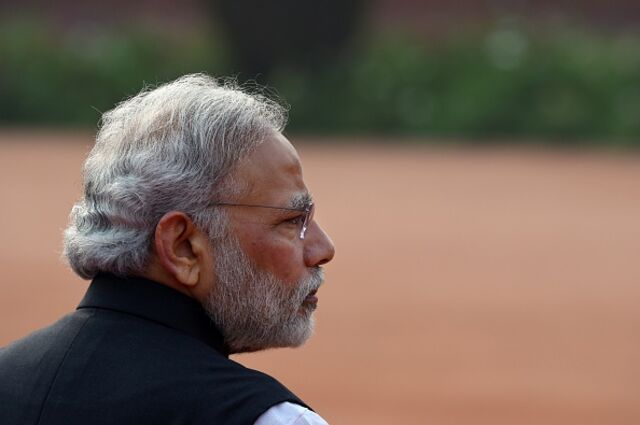
<p>Quiet too long.</p> Photographer: ROBERTO SCHMIDT/AFP/Getty Images

QUIET TOO LONG.
 PHOTOGRAPHER: ROBERTO SCHMIDT/AFP/GETTY IMAGES

Facebook

Twitter
LinkedIn
Google+
Email
INDIA
The Leadership India Needs From Modi

OCT 25, 2015 6:00 PM EDT

By Editorial Board
The sectarian climate in India has grown so toxic, Prime Minister Narendra Modi has been moved to reprimand several officials of his own party for making inflammatory anti-Muslim comments. It's a first step toward calming the situation, but Modi will have to do much more. 
During his year and a half in office, Hindu radicals have assumed a new prominence across India. In Mumbai, the country's most cosmopolitan city, thugs have disrupted events featuring Pakistani writers, singers and sports administrators, and the local Hindu nationalist government has banned dance bars, lingerie-clad mannequins and Valentine's Day. An increasing number of states are enforcing laws against the slaughter of cows (a cause Modi himself has espoused) and in some cases, the sale of beef. Mobs enraged at rumors of beef-eating or cow-slaughter have recently killed at least three people. Three other murders of secular writers and thinkers have spurred high-profile authors to return their awards to a national arts academy, to protest its failure to condemn the attacks more loudly.
While Modi has been careful to keep his own rhetoric measured and to focus on economic development, many of the figures driving these campaigns are members of the Hindu supremacist Rashtriya Swayamsevak Sangh organization, which has long provided Modi's most loyal foot soldiers. What's more, several officials from Modi's own Bharatiya Janata Party have made statements that appear to condone the Sept. 28 lynching of a Muslim man less than 30 miles from Delhi. Lower-level politicians and Hindu ideologues have reason to assume party leaders approve of their actions. 
Their extreme pro-Hindu rhetoric threatens to alienate the moderate voters who swept Modi into office last year. An even greater danger is that vigilantism will become accepted. It's up to the government to ensure that police vigorously investigate all the recent killings. And any BJP ministers and legislators who continue to incite hatred should be swiftly removed from office. 
Above all, Modi must put his abundant rhetorical gifts to work against sectarianism. So far, he has hedged -- waiting two weeks to condemn the Sept. 28 lynching and neglecting to reach out to the victim's family. The central government, he told one interviewer, had no role to play in a local law-enforcement issue. 
Leadership requires that Modi move more forcefully against the spreading tension. He should tell his supporters that when Hindus speak or act against Muslims, they dishonor their faith and India's proud multiethnic history, betraying the message of opportunity for all that brought Modi to power. India has much sad experience with unscrupulous politicians twisting and snapping the bonds between its many faiths and ethnic communities. Modi's foremost responsibility is to preserve and reinforce those bonds. 
His vision for India -- a modern, clean, efficient nation in which people focus more on economic opportunity than caste or sect and where foreign investment bolsters growth -- is incompatible with the angry majoritarianism that some of his supporters espouse. Modi has to make sure they understand that.
To contact the senior editor responsible for Bloomberg View’s editorials: David Shipley at davidshipley@bloomberg.net.


Saturday, October 24, 2015

Eroding freedoms in India

We need to wake up and preserve what has allowed each one of the 1.25 Billion to do what we want to do; the freedom to speak, assemble, write and question the government.

The essence of democracy is freedom and "ability" to question the leaders. If we choose not to question them, we would be supporting trends that will start stripping our freedoms. Mr. Modi has to speak up and stop this mayhem, and not give a tacit approval to the extremists among us.
Blind love for the leaders had messed up India during Indira Gandhi, and now, some of us are blinded again and it is not good for India. 


A concerned Indian
Mike


What the latest Sahitya Akademi resolution tells us about the right to dissent

The writers remind us that the task of dissenting is never done. 
  · Today · 08:30 am

Photo Credit: IANS

 
For a country that never fails to remind itself and the world that it is the world’s largest democracy, we seem to be singularly lacking in one of the qualities essential to a truly democratic society: an appreciation of the principle of dissent. In recent times, nowhere has this lack been more obviously visible than in the curious backlash against the artistes who have surrendered their Sahitya Akademi awards.

Now numbering close to 40, the artistes who have returned awards write and perform in a number of Indian languages, and include in their distinguished ranks Nayantara Sahgal, GN Devy, Keki Daruwalla, and Krishna Sobti. Others, such as Shashi Deshpande have resigned from positions in the Akademi.

As Ramachandra Guha pointed out in a column recently, these writers are not necessarily aligned with any particular political party. A host of other Indian writers, thinkers, and intellectuals, such as Amitav Ghosh and Vikram Seth, have strongly supported the right of the artistes to signal their dissent through their act.

Three related protests

The returning of the awards by the writers signals three related acts of protest.

First, against rising intolerance in the country, seen, for example, in the chilling murder of Kannada scholar MM Kalburgi and in brutal attacks on religious minorities.

Second, against the Sahitya Akademi for refusing to take a strong stand on the Kalburgi assassination and the general climate of hostility against writers in the present moment.

And, third, against the Indian government for its inaction and silence on both these counts.

The act has triggered angry denunciations by politicians in the government, accusations by right-wing columnists of a selective “hatred” of the Modi government, mumblings about the double standards of the writers by disgruntled celebrities such as Anupam Kher, and incoherent tweets by Censor Board member Ashok Pandit.

The particular substantive objections to the writers notwithstanding, the principle of dissent and the right of the writers to dissent has completely been set aside in each of these objections. The same erasure can also be seen in the flood of tweets by the Indian right-wing on Twitter.

The ease with which the fundamental right of dissent – which belongs not just to Indian writers but to all Indian citizens – is ignored and deemed irrelevant reveals something fundamental about the nature of the social context in which the protests are occurring.

Knowing their place

It is a reflection of the deep-seated social conservatism of Indian society, expressed as a contract, tacit or explicit, that every person should know their place in the great chain of Indian being.

Writers, in this Indian scheme of things are meant to write and tell stories, not to protest. Each writer is meant to illuminate his or her little corner of the world, based on his or her experience, in his or her chosen language, for his or her audience. As long as they don’t offend the religious sensibilities of their own or other communities or speak up against the nation.

This sentiment is perfectly summed up in the words of Bharatiya Janata Party politician Vijay Goel: “Writers should be concerned with their pen only, otherwise giving awards would be stopped.”

Differential privileges

Indian politicians, in contrast, have the licence to say the most outrageous things in the name of politics, because, well, this is what they do, what we expect, and endlessly put up with. We forgive the most offensive statements by politicians, the ugly entitlements of Very Important People culture, and allegations of crimes – heck, we even forgive pogroms.

The principle of differential privilege shapes any number of assumptions about which kind of Indian is entitled to exactly what.

Thus Indian hearts, regardless of where their political sympathies lie, bleed when a film star might have to serve time for involvement in a crime leading to deaths but the same hearts remain indifferent to the ordinary undertrial languishing in jail on the flimsiest of charges without the possibility of bail.

It is considered perfectly legitimate for a banker to travel first class to India on the Indian government’s tab, but woe betide Amartya Sen if he at 81 does not want to suffer the abominations of economy class air travel on a flight from the United States to India.

It is why Indians who talk a good game about caste, class, and religious equality see no contradiction between holding forth about the evils of apartheid South Africa without once asking the "drivers" and "servants" working for them to sit on their living room sofas.

The greatest transgression of the writers, then, has been to exceed their brief as Indians, to speak out of turn. This explains the curious paradox, pointed out by Mitali Saran, of any numbers of Indians raging against unpatriotic writers even as they insist simultaneously on the irrelevance of the same ungrateful bunch.

Perceived disrespect 

With the afterglow of the Modi honeymoon fading away, the heresy committed by the writers converges with a perceived disrespect for India, with India itself deemed indistinguishable from the larger-than-life, well-coutured, globe-trotting personality of Modi. If India was Indira in the context of the non-aligned world, on the global stage India is Modi, all tricolour and Facebook, both pizza and pizzazz, at once technology and tradition.

In the conservative Indian imagination, the writers returning awards are thus guilty not just of behaving badly at home but of throwing tantrums in public too. We are now in the familiar Indian territory of besmirching honour and naak katwa di, of betraying family, community, religion, or nation.

This, of course, is democratically applied across the board in India, from the child who does not clear some competitive exam to the son or daughter who chooses their own life partner, from the H1B holder who gets laid off in the US to the middle-aged vegetarian man who gets caught out for eating a mutton roll at a roadside stall.

We should thank the writers all the more then. In addition to their courageous gesture of protesting the attacks on minorities and writers, and the sloth of a cynical government, they remind us there is much, much more we need to protest about. And that the task of dissenting is never done.

In the day since I initially wrote this article, the Akademi has finally responded to the protests. In a clear statement it has denounced the violence against writers and affirmed its commitment to free speech, also requesting the writers to take back their awards. For whatever it is worth, it has also recognised that the right to disagree and dissent, whatever its object, is inherently precious to a democracy.

Tuesday, October 6, 2015

Pakistan, India and Kashmir Peace Talks - Why War Is Not An Option.

Note: Mona is one of my favorite Muslim human rights activists and I admire her for her work. I wish, I could attend the program, as I am deeply involved in the Anti-Muslim protests and solutions there of, and then go to Salt Lake City for the Parliament of Worlds Religions. 

Please participate in the symposium and things will change if you do something about it and Mona is doing it. Give her the support

Mike Ghouse
http://RedeemingPakistan.blogspot.com
http://MikeGhouseforIndia.blogspot.com 

# # #

Pakistan, India and Kashmir Peace Talks - Why War Is Not An Option.

By Mona Kazim Shah

This symposium is scheduled for the 10th of Oct, 2015 at UT Dallas at 2 PM at Naveen Jindal School of Management. It is organized by #ProjectPakistan, an ongoing campaign that speaks for human rights issues, has philanthropic projects, political radio shows, provides space for open mics, and is working diligently to encourage dialogue to resolve conflicts and promote South Asian art and culture in the U.S.

The focus of this symposium is to bring the youth from Pakistan, Kashmir and India on one forum and to instigate peace talks and healthy dialogue that will finally take their voices further. Since we will be micro blogging and streaming the event live for the participation of the audience in the region, we expect our voices to reach back home. We believe the same youth will be part of our government, bureaucracy, policy making and pressure groups in a very short time and is capable to take these talks to the next level. They have shown serious political acumen and the will to re-open the frozen issues, such as the one under discussion.
The panelists are pro peace, pro dialogue Journalists/Academics/Activists/Artists who have worked in their own capacities for years and have paid a price for it.

 Beena Sarwar, a journalist, artist and documentary filmmaker from Pakistan (focusing on media, gender, peace and human rights issues) who also work part time as Editor, Aman ki Asha, a peace initiative between the Jang Group of Newspapers, Pakistan and The Times of India. I asked her about the fact if any change should be expected from younger generation of government/bureaucracy? Her answer was in affirmation she also added that, “Politicians, business people and even a common person is capable of bringing about a change, the younger generation doesn't have the baggage or carry the animosity. Most want to live in peace and have good relations. I believe that the change is happening, but it will take time” Beena said optimistically. Beena currently teaches Journalism at Brown.

Raza Ahmad Rumi, a Pakistani journalist and policy analyst who serves as an editor at The Friday Times, Pakistan's foremost liberal weekly paper, had an interesting analysis about the role that media can play in bringing India, Kashmir and Pakistan on the same page. According to Rumi, “The media is a powerful player now, even stronger than state actors. It has a vital role in shaping public opinion for peace-building. However, the disturbing corporatization of media means that you have to sell conflict for profits. This is why peace and diplomacy find less traction and more sensational stuff is witnessed. This has grave implications for the future peace efforts”.


Rumi, himself survived an assassination attempt by religious extremists in Pakistan last year. Rumi’s book, Delhi by Heart: Impressions of a Pakistani Traveler is a must read.

Dr.Amie Maciszewski, an international musician, a Sitarist who will be opening the symposium with a Kashmiri folk tune told us how her life has been about liminality: negotiating borderlands and building bridges. She has been studying and practicing expressive traditions, particularly music, of a complex region like South Asia.  For her Kashmir is one such borderland which has been enriched by intercultural encounter, dialogue, and collaboration.  Amie believes, Symposia like this are most important steps towards dialogue, collaboration, and, ultimately, mutual enrichment.

At this much anticipated event, we also have Dr. Pritpal Singh as a panelist. A Physician who has always stood up and addressed Human Rights Issues with great passion.  He is an executive with Cigna. He facilitates workshops and projects which aim to fight both religious and political oppression through reflection, awareness, and activism.  Dr. Singh is a frequent guest speaker at the educational, religious, and social forums.  Dr. Singh believes, “Conflict only furthers tensions and creates more divisions, solutions that take the route of peace are the only ones that provide political and social harmony and is of optimal value.”


Dr. Nyla Ali Khan is on the faculty of the Expository Writing Program and the Women’s and Gender Studies Program at the University of Oklahoma. She is a native of Kashmir, and a native speaker of the Kashmir language.

 Dr. Khan believes that the younger generation of Kashmir has witnessed the militarization of the Valley and has grown up in a traumatized environment. She told me that when she interacted with young people at various academic institutions, she realized that they have tremendous potential.  Dr. Khan said, “I hope the right opportunities are created for them, not just in academia and the government sector, but in the private sector as well” She hopes that young Kashmiris tap into the potential that they have, “only then there is hope for light at the end of the tunnel”.

Nyla Ali Khan has most recently edited a major anthology, The Parchment of Kashmir: History, Society, and Polity, which develops an unparalleled understanding of the region’s culture, resilience and fate as political pawn. Her recent book, ‘The Life of a Kashmiri Woman’ a critically acclaimed work, is a hybrid form of academic memoir and biography on her maternal grandmother, Begum Akbar Jehan. Nyla’s goal is to engage in reflective action as an educator questioning the erosion of cultural syncretism, the ever increasing dominance of religious fundamentalism, and the irrational resistance to cultural and linguistic differences.

Amitabh Pal is the Managing Editor of The Progressive. He has interviewed the Dalai Lama, Mikhail Gorbachev, Jimmy Carter and John Kenneth Galbraith. In addition to his role as the Managing Editor, Pal is the Co-Editor of the Progressive Media Project. He is the author of "Islam" Means Peace: Understanding the Muslim Principle of Nonviolence Today.
Quoting one of Amit’s articles, “The international community including the United States, the European Union and other nations has pressed for India and Pakistan to resolve the Kashmir issue”

According to Pal, “Indians and Pakistanis deserve a better future than the fate their leaders have bestowed on them for more than half a century and both countries need to work toward that -- step by step”.

The panelists, the audience and the city look forward to this very timely and important discussion that may lead to positive results. This is yet another effort in the name of peace by the people who truly believe that war has not and will not solve anything.  We are done with the tired rhetoric and losing innocent lives on the borders. All three regions can use the money it invests on defense on development, health care and education of its masses.
We would like to thank our partners and supporters for trusting us and our efforts for this Peace Symposium and for joining hands with us in making a difference.  We thank United Nations Dallas Chapter (UNAUSA Dallas),  Pakistan Students Association UT Dallas, Indian Students Association UT Dallas, Embrey Human Rights Program Deadman College, Southern Methodist University (SMU), Never Forget Pakistan, Pakistan Society of North Texas (PSNT) Fun Asia Radio, Dallas, Voices Breaking Boundaries (VBB), Dallas Peace and Justice Center, Pakistan Students Association UNT, Indian Students Association UNT and World Echoes  from the bottom of our hearts.


About the Author: Dr. Mona Kazim Shah is the Founder of #ProjectPakistan, Journalist and Human Rights Activist. Dr. Shah is currently pursuing her master’s degree in Global Studies and Human Rights & Social Justice from Southern Methodist University. She lives with her husband and twin daughters in Dallas.  She can be reached at monakazimshah@gmail.com

Monday, October 5, 2015

Qawwali Lessons (Washington DC) - the beautiful language of inclusion.

Qawwali in Washington | TheGhouseDiary.com 

Saturday, October 3, 2015 - Washington, D.C. – The Qawwali* program at Turkish Community Center Auditorium in Lanham, MD was out of the world. Here are some of the notes I have made, and hope it resonates with you.   

First thing first, I am pleased to share the emotional side of the equation. Being a pluralist and a human aspirations observer, whenever and wherever people include each other in their normal conversation it brings happiness to both the includer and the included.

When they sang, “Bhar do Jholi meri ya Muhammad… and came to the line, “O Muhammad ka pyara Nawasa”… every one rejoiced it, but particularly men and women from the Shia tradition, by going to the stage and honoring the Qawwal (singers) in the traditional way by doing money aarti (honor) and placing it on their harmonium, lap or even their head, a beautiful tradition of telling, we like you.

I was in a different world, the world of harmony and inclusion, my eyes soaked and I felt tender with joy. I was happy!  I was happy to see the Shia community feel included.

Of course most of the Qawwali lines have the name Ali included in it as a reverence to Hazrat Ali (RA), but when the lines include the “Nawasa” that is grandson of the Prophet, it has special significance to all, but particularly the Shia tradition.  Video at Facebook - https://www.facebook.com/MikeGhouse/videos/10156190763450249/

You know what I wished? I am sure you are wishing the same; i.e., to have our language routinely include each other’s revered figures with utmost respect. Karbala or Kurukshetra, our language should be inclusive, it builds a society of harmony.

We may consider sprinkling some of the inclusive poetry amidst all other poetry recitation or singing. Mahatma Gandhi’s favorite Bhajan “Allah Tero Naam, Eshwar tero Naam” or many a Sahir Ludhianavi or Shakeel Badayuni numbers like “Yoshadha Ki Humjins, a hawwa Ki beti” need more circulation.  I have been asking every visiting poet to recite or write at least one inclusive poem in the evening.  God willing, I will continue to write a poem an event to reflect that inclusiveness.

When President of the United States says Happy Diwali, Eid or Baisakhi, we gloat and share it with everyone we know. If a congressman or a woman says Satsri Akaal, Jai Jinendra, Yali Madad, Namaste or Salaam, we gloat.  The idea is inclusion, to be treated respectfully and to be acknowledged. 

Reverse this to India and Pakistan, and see how deprived the minorities of each nation are. The Prime Ministers of both India and Pakistan do not have the courtesy to greet their minorities on their happy occasion. May God give them guidance to believe at least in their own respective religions, both are inclusive and consider the world as one family.

Minorities (religious, ethnic, social, cultural, linguistic and other uniqueness) make sincere efforts, and at times go out of their way to be a part of the larger society, they want to be included and do everything to achieve it. The smart leaders acknowledge it, and let the public focus on being constructive rather than get stuck in denials.

I hope most of us Desi Americans have learned and enriched ourselves with the rich American Culture where all humanity is respected institutionally. 

We have a choice to be inclusive and let our “Zindagi Shama’ ki soorat ho khudaya meri” and “ her jaga mere chamak ney say ujala hojaye” rather than rot with exclusion.

The consistent rhythmic beat of the Tabla, and the special voices, the inflections in singing is entirely different and gets you become a part of it.

The second item of beauty of this program was the Qawwals themselves, the Qawwals and their humnawa were a great combination, the acoustic of the auditorium ne to chaar chand lagagiye unki gayeki mein.  They were Christians, and my friend sitting next to me was a Hindu enjoying the Qawwalis. He was singing along Bhardo Jholi meri ya Muhammad. This is a (or was it?) a common tradition in India. The Qawwals can be Muslims, Hindus or Sikhs and they can sing devotional songs of any religion. I hope more of this happens now.

In the short few minutes we had between the program and break I had wonderful conversations with Fazal Khan, Razi Raziuddin and Zafar Iqbal.  They have rich stories of uthna, baithna, khana peena with their Hindu friends. I request each one of you to  start writing those stories… let our youth understand the beauty of enjoying life and hope people in India, Pakistan and elsewhere can rework inclusion in their lives.  


I hope and pray, some day we all can see the message of Jesus, Krishna, Muhammad, Guru Nanak as our own message, when we do that each one of our faiths will reach the higher level of spirituality. Amen!

·      Qawwali is a special format of singing, usually in praise of revered figures for their good work.

Link to pictures of the event will be added here upon receipt. 

Please note: 

Are you concerned about Muslim bashing in America? Find out what the newly formed American Muslim Institution (AMI) is doing about it on Sunday, October 11, 2015 - details atwww.AmericanMuslimInstitution.org 


Thank you
Dr. Mike Ghouse is a social scientist, thinker, writer and a speaker on  Pluralism, Interfaith, politics, human rights, Islam, foreign policy and building cohesive societies. Mike offers pluralistic solutions on issues of the day. More about him in 63 links at www.MikeGhouse.net and his writings are at TheGhousediary.com  

Will Modi speak up?

 Can we expect Prime Minister Modi to speak up? | http://MikeGhouseforIndia.blogspot.com 

All he has to say, and I earnestly hope, the Indian Americans would support this, as we enjoyed the freedom this nation offers. I hope we are American enough to expect PM Modi to say this.

" I will not tolerate any one undermining another Indian, to me all Indians are equal and everyone has a right to eat, drink, wear and believe whatever one wants, any one trampling other Indian's basic human rights will be punished and I see to it that it happens. I have a the responsibility and my faith Hinduism teaches me to respect every human and I will."

Do you agree with this?
As Indian Americans, we welcome this petition:

Progressive Hindus denounce murder of Mohammed Akhlaq

HAF has taken a bold step, and I am sure its not easy to do the right thing.
http://www.hafsite.org/hindu-american-advocacy-group-condemns-lynching-muslim-man-india


The world would be a better place if we develop the ability to stand up for others - a Hindu for a Muslim, a Muslim for a Jew, a Jew for a Zoroastrian...
 Take a look at this - Standing up for Hindus, it needs to be updated
http://standingupforothers.blogspot.com/2012/04/standing-with-hindus.html 
Thank you,

Dr. Mike Ghouse is a social scientist, thinker, writer and a speaker on  Pluralism, Interfaith, politics, human rights, Islam, foreign policy and building cohesive societies. Mike offers pluralistic solutions on issues of the day. More about him in 63 links at www.MikeGhouse.net and his writings are at TheGhousediary.com   


Friday, October 2, 2015

Lessons from Gandhi - Today is his birthday

LESSONS FROM GANDHI | http://MikeGhouseforIndia.blogspot.com 

Mahatma Gandhi is one of the 7 humans I look up to and admire whole heartedly, it does not mean there are only seven, but these magnificent seven are always on my mind, if not every other day, definitely once a week- Chronologically they are; Jesus Christ, Prophet Muhammad, Mahatma Gandhi, Mother Teresa, Martin Luther King, Pope Francis and Barack Obama. These men and women are true pluralists, no one falls out of the ambit of their love. They are a blessing to mankind. 


More about Gandhi at: http://theghousediary.blogspot.com/2014/10/mahatma-gandhi-do-not-poison-your.html

Thursday, October 1, 2015

Is Hinduism a religion of violence?

Where are the Moderate Hindus | http://MikeGhouseforIndia.blogspot.com 

Where are the moderate Hindus? If the moderate Hindus don’t speak up, shamefully Hinduism will be slapped with the label of religion of violence.  In the last year and half, India has witnessed relentless harassment of the Dalits, Muslims and Christians. This week a man is mercilessly beaten to death by a mob with bricks for supposedly eating beef, which he did not per the police. 


India had a glorious civilization and the extremist among Hindus cannot mess with it, unless we let them.  Our past was made up of respecting the otherness of others, but today, we are going in the opposite direction.

Was our civilization bad? 


Eating beef has been made a crime in India now. If unchecked, India will regress and the glorious past will be equated with stupidity for forcing and harassing people to obedience as the ISIS brutes do.   Our civilization was a great civilization and we cannot let a few misguided ones ruin India's pluralistic ethos. 

I like to see an India where one has the freedom to eat, drink, breath, wear or believe whatever the hell he or she wants.

I do expect Americans of Indian origin to speak up, hoping that they have learned the value of freedom in America, where we mind our own business and eat whatever we want to. 


Mike Ghouse
http://www.washingtonpost.com/news/morning-mix/wp/2015/09/30/a-mob-in-india-just-dragged-a-man-from-his-home-and-beat-him-to-death-for-eating-beef/?tid=sm_fb


Thank you

Mike Ghouse
(214) 325-1916

Dr. Mike Ghouse is a social scientist, thinker, writer and a speaker on Pluralism, Interfaith, 
Islam, politics, foreign policy and building cohesive societies. Mike offers pluralistic solutions on issues of the day. More about him in 63 links at www.MikeGhouse.net and his writings are at TheGhousediary.com