HOME | ABOUT US | Speaker | Americans Together | Videos | www.CenterforPluralism.com | Please note that the blog posts include my own articles plus selected articles critical to India's cohesive functioning. My articles are exclusively published at www.TheGhouseDiary.com You can send an email to: MikeGhouseforIndia@gmail.com


Showing posts with label Mike Ghouse for India. Show all posts

Sunday, July 21, 2019

The Indian synagogues preserved by Muslims

Every time I read about Indian Jews leaving India, I wish they had not, then I realized that I have left India too, but of course, Indian blood runs in my veins. Two of the famous Indian Actors were David, who went to Canada, and Nadira (Film AAN fame with Dilip Kumar) died in 2016.
Mike

The Indian synagogues preserved by Muslims

By Kalpana Prodhan & Sreya Chatterjee 18 April 2019
Courtesy BBC News 
For more than 100 years, the synagogues in Kolkata, India, have been cared for by Muslims in a shining example of friendship uniting faith.
Pictures courtesy Getty’s image
       

Birth of the ‘Baghdadis’

For nearly 140 years, from 1772 to 1911, Kolkata was the capital of British India – a bustling commercial city on the bank of the Hugli River in the heart of West Bengal. Its strategic position, roughly 150km upstream from the Bay of Bengal, not only brought foreign trade, but also enticed several foreign communities – from Chinese to Armenians to Greeks – to migrate to the thriving city. Among them were Jews from the Middle East.
Known as ‘Baghdadis’ or ‘Baghdadi Jews’ because of their origins in modern-day Iraq, Syria and other Arabic-speaking places, Jewish immigrants began settling in Kolkata in 1798 after a trader named Shalom Cohen came in search of riches. As news spread of Cohen’s success in the trade of diamonds, silk, indigo, opium and cotton, Kolkata’s Jewish population grew rapidly, and by the early 1900s, thousands of Jews were living harmoniously alongside Kolkata’s many Hindus and Muslims.

Disappearing act

After World War Two, as many as 5,000 Jews resided in Kolkata. During the community’s peak in the 1940s, Kolkata was home to five synagogues, as well many Jewish businesses, newspapers and schools. Today, what was once India’s largest Judaic community has dwindled to fewer than 24 people, as many Baghdadi Jews have immigrated to Israel, the US, Britain, Canada and Australia.
Yet, while Kolkata’s Judaic population ages and shrinks, its remaining community continues a cross-cultural tradition that has existed for the past three generations: its three remaining houses of worship are maintained and cared for by Muslim men.

Family across faiths

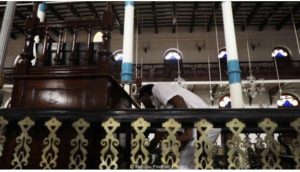
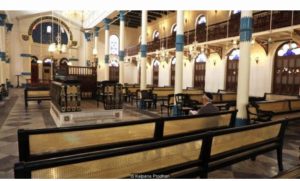
Climbing the marble staircase and pushing past the stained glass window of Kolkata’s Beth El Synagogue, built in 1856, visitors may come across a rare sight: a team of four white-clad Muslim men busy polishing the wooden balconies, sweeping the chequered marble floors and ensuring that the Star of David and seven-pointed menorah adorning the building’s sand-coloured facade are clean.
Several of the caretakers, such as Siraj Khan, a third-generation Muslim employee whose family has been maintaining the synagogue for more than 120 years, have grown up alongside Beth El’s few remaining members. According to AM Cohen, general secretary of Kolkata’s Jewish Community Affairs, Khan and the other Muslim caretakers of the city’s synagogues are considered part of the Jewish family.

Religious relatives

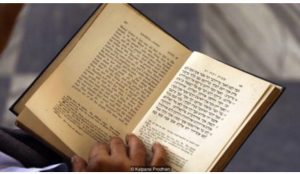
Just 300m from Beth El, one of Kolkata’s other remaining synagogues, Magen David, a towering Italian Renaissance-style red-brick building, is also maintained by four different Muslim men whose families have looked over the temple for generations. Like at Beth El, after the caretakers unlock the doors and turn on the altar lights, illuminating Hebrew inscriptions of the Ten Commandments, the workers often gather in a courtyard to unfurl a prayer rug towards Mecca and bend in prostration to Allah.
According to Jael Silliman, one of Kolkata’s last remaining Jews and author of the digital archive Recalling Jewish Calcutta, which aims to preserve the memories and legacy of the city’s Jewish community, there has always been a cultural familiarity between Muslims and Jews in Kolkata, as the earliest Jewish immigrants to the city spoke Judeo-Arabic and wore Arabic attire.
Beyond Kolkata, the two religions have a long history of overlap. Fittingly, during the tumultuous years before and during World War Two, many European Jews fled Nazi Germany and found safe refuge in Kolkata. Like their Jewish Middle-Eastern predecessors, these newly arrived European refugees soon found that they had a lot in common with the Muslims who made up Kolkata’s largest minority group – from similarities between kosher and halal food to their music and dance.

Special bond

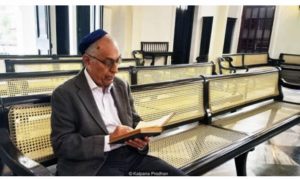
“God is everywhere, be it a mosque, temple, church or synagogue, and working in this quaint synagogue is a service to God that I do wholeheartedly,” said Khan (pictured), whose grandfather and father cared for the Beth El Synagogue, and who now maintains it alongside his brother.
“His name or form is not to be differentiated when the language of love and kindness is spoken. And this special bond is what I feel with this synagogue.”

Melting pot

West Bengal is home to India’s third-highest concentration of Muslims, and Kolkata, its capital, has always been something of a haven for religious tolerance. While the majority of the 4.5 million population is Hindu, Muslims, Christians, Jews, Buddhists and Sikhs from across the world have long co-existed in the so-called ‘City of Joy’.
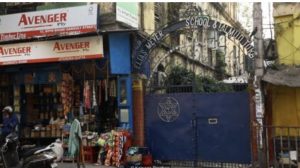
Today, it’s not uncommon in Kolkata for Hindus to join Muslims in mosques to celebrate the Eid-al-Adha ‘Festival of Sacrifice’ – one of the holiest Islamic holidays. The Jewish Girls’ School that was established in Kolkata in 1881 is now predominantly Muslim. And every year during the holy Hindu celebration of Durga Puja and the Christian Christmas festivities, a sea of Bengali revellers, regardless of religion, routinely take to the streets to dance.

Fading away

According to AM Cohen, a few factors led to Kolkata’s Jewish population disappearing after the end of World War Two.
First, India’s independence from Britain in 1947 signalled an uncertain time for India’s Jews. Banks and businesses became nationalised, and many Jewish property owners, fearing their assets may be taken by the Indian government, moved to Britain or the US.
In addition, the creation of the state of Israel in 1948 spurred a steady migration of Jews from India and from around the world to the new country.

Uncertain future

Today, Kolkata’s dwindling Jewish population faces a very uncertain future. While both the Beth El and Magen David synagogues are now recognised as protected heritage buildings by the Archaeological Survey of India, they – along with the city’s oldest synagogue, Neveh Shalom – haven’t held regular Saturday services since the late 1980s due to a lack of attendance. According to the Jewish minyan congregational quorum, 10 adult males must be present to sanctify public prayer, and there aren’t enough Jewish men left.
In the 1940s, Ian Zachariah, treasurer of Emunah Calcutta Jewish Trust, remembers that the wooden seats at Kolkata’s synagogues used to be filled with hundreds of worshippers during the High Holidays of Rosh Hashanah and Yom Kippur. Now, the three buildings are only open by special appointment or by asking one of the Muslim caretakers, who are paid to look after the temples by the Emunah Calcutta Jewish Trust, to enter.
Of the 24 or so Jews who continue to live in Kolkata, most are over the age of 50 and older than their Muslim brethren who continue to maintain the synagogues.

An Indian inspiration

As violence and political tension against Jews and Muslims continue to draw headlines throughout much of the world, Kolkata’s Muslim caretakers and their commitment to looking after these Jewish synagogues are a reminder that these two communities share much in common, and the importance of loving one’s neighbour.
Kolkata’s Jewish population may soon fade away, but as long as there is someone to care for the temples, open the doors and let visitors in, a part of their heritage will live on thanks to their Muslim brothers.
Video by Kalpana Prodhan, text by Sreya Chatterjee.
Breaking Barriers is a BBC Travel series featuring inspiring tales of unity and humanity in theatres of dispute and division.

Friday, December 15, 2017

Why are Hindus trying to prove that they can become ISIS-like extremists


Taslima Nasreen’s article is worth pondering, for a good change, she has appealed to common sense. Although the radicals among Muslims and Hindus may not like this, she has brought a few unresolved issues to the fore. This note is not about Hindus or Muslims, but about dealing with the radicalized among us.

Taslima has however senselessly stoked the Hindu fears by using the phrase ‘divide India.’ To Muslims it means discrimination whereas to Hindus it reaffirms the ‘Pakistan phobia’ that Modi stokes regularly. 

I have written several pieces on reconciliation and mitigation of fears among the radicalized ones, it is time we hold a national conference on this subject in the likes of what Nelson Mandela did in South Africa.  In almost every conflict we’ve seen in India, the following revengeful epithets have been thrown: Babar ki Aulad, Aurangzeb, Somnath, Guru Gobind Singh etc ad-nauseam.

There are a lot of myths out there that need to be brought into open and demystify them. We (all Indians who care for an India where every Indian feels secure) cannot change the hard core men and women, but strengthen the majority who sits on the fence and earn their support with facts. It is a long term effort to build a cohesive India where no Indian has to live in apprehension or fear of the other. Indeed, that was the unstated goal of Hinduism, Islam, Christianity, Sikhism and all religions.

There is a thought worth exploring; the base instinct in human beings always seeks a target to attack (or hate) to dump their inexplicable anger on someone, to seek false security by creating chaos and fear among the targets.  Until the British directed the manufactured ire of Hindus towards Muslims as a part of divide and rule, their hate in the form of denigration was directed at the Dalits for several centuries, now it is redirected against Dalits, Muslims and Christians. As responsible citizens, we need to find channels to direct their anger and bring a sense of security to them. Please remember it is not about Muslims and Hindus, it is about the radicalized among us.

Should Muslims defend the bad deeds of the Kings in the past who happened to be Muslims? Should Hindus take their anger out on Muslims of independent India who have nothing to do with those kings? 

Part of the reconciliation includes summary from our historians to put a brief history of kings; Hindu, Muslim, Christian, Buddhist, Sikh, Zoroastrian and others. Wasn’t purpose of every king to loot and annex the next door land? Plunder the wealth of the weak? Don’t we find good and bad kings among all traditions? Was it their lust for power that drove them insane rather than their religion?  What has religion got to do with their greed?


Thanks our founding fathers for bringing us our government by us for us. 


On Dec 15, 2017, at 10:08 AM, Mohammad Imran wrote:
Supporters of Shambhulal want to prove that Hindus too can become extremists like Muslim extremists. Shambhulal may be in jail, but thousands of Shambhulals are walking about free with their anger, disgust, and hatred. How many of these people can be jailed to maintain peace? How many Muslim people can be liberated from their daily fears and apprehensions?

We are all Indians, South Asians — religion, caste, language, history do not constitute our identity. Our love and compassion is our identity.


Courtesy : Getty Image

Why are Hindus trying to prove that they can become ISIS-like extremists: Taslima Nasreen
TASLIMA NASREEN 14 December, 2017
  
(Representational image) Activists of Bajrang Dal during a bike rally in Jammu, India. Photo by Nitin Kanotra/Hindustan Times via Getty Images

This is the kind of politics that divided India once, and may divide India again, writes author Taslima Nasreen.
I have not watched how terrorists hacked to death the Bangladeshi freethinkers Abhijit, Bijoy, Washikur, Deepan.
But I have seen how Shambhulal brutally murdered Afrazul in Rajasthan, courtesy his nephew’s video on the internet. The murder-video was broadcast on the internet, just like ISIS does. ISIS knows that in their strongholds in Syria, no police will come to arrest them. Shambhulal probably also thought that no one would punish him.
Both kindness and savageness exist inside human beings. Some people mute the savage in them, others the kindness.
Shambhulal does not suffer from mental illness. He was cold and composed while he hacked Afrazul to death. But what was Afrazul’s fault? He is a poor man from a poor village in West Bengal. Many from his native village come to Rajasthan and other states as labourers. Afrazul was almost 50 years old, and he was not falsely enticing a Hindu-woman to marriage or converting her.
Friends of Shambhulal have said that the he used to love a Hindu woman but that woman had a relationship with another Muslim man. However, that man was not Afrazul. This woman once ran away with her Muslim lover to West Bengal and Shambhulal went after them to bring her back. Apparently, he got beaten up by some Bengali Muslim workers there.
Many women ran off from Shambhulal’s village and married Muslim men. Some say Shambhulal killed the first Muslim man he got his hands on and killed him to instill fear in Muslim men who marry Hindu women to convert.
The question is: how did Shambhulal gain this ISIS-like courage? Are there other people like him, who support his opposition to Muslims? He assumed he wouldn’t be condemned, but praised.
When I criticised the brutal murder-video on Twitter, many people rose up to support him. Earlier when I condemned gau rakshaks beating innocent Muslims to death, I faced similar ire from the Hindus. They threatened me that I must not utter a single word against Hindus while sitting in India. If I don’t appreciate Hindu culture and traditions, then I should leave the country at once.
Intolerance is at its peak now. I have discussed irrational Hindu rituals and oppression of women earlier but never received such threats. For me, humanity, equality, liberty and generosity have always been greater than any religion. Because I have criticised one specific religion does not mean that I like all other religions.  If religious notions do not change with time, religion will continue to be intolerant. Then people will have to discard religion for humanity, or cleverly assimilate humanity into religion.
The more religious intolerance increases in India, the more the non-religious people are hated and anti-women sentiments celebrated. This is why the release of Padmavati was stopped or people who kill Muslims for eating beef can enjoy impunity. Or why the people who murdered Kalburgi and Gauri Lankesh cannot be traced.
I do not want to accept this changed India and I hope these changes are temporary.
Popular television channels or newspapers treated Shambhulal’s murder and the video like it was just another everyday murder. But it was not. ISIS terrorists wear masks when they kill, Shambhulal did not.
The point of the video is that Muslims can be killed easily. They can be killed because they invaded India, destroyed temples and plundered villages, converted Hindus, took over a Hindu land and ruled over Hindus. And now, they have commenced ‘love jihad.’ Muslim men are apparently faking love to marry Hindu women and converting them to Islam. This is what Shambhulal wants to stop. He will not let Hindu women marry Muslim men under any circumstance.
In opposition to ‘love jihad’, Hindus are doing their own ‘ghar wapsi’ where Muslims should leave behind Islam and accept Hinduism as their faith. Both ‘ghar wapsi’ and ‘love jihad’ are equally deplorable ideas and true love between a Hindu-Muslim couple should not be denied or made the subject of humiliation.
However, the question is: why should Afrazul pay for the mistakes of Muslim invaders in the past?
On 6 December, 1992, after Hindu fundamentalists destroyed the Babri Masjid, Muslim fundamentalists in Bangladesh took revenge by burning down a Hindu temple. Why did innocent Hindus in Bangladesh pay for the crimes of the Hindu fundamentalists in India? And those who think innocent Hindus are not responsible for Babri Masjid demolition, do they also think that innocent labourers like Afrazul should not have to pay for Muslim invaders? If people consider this fair, then they believe in divisive politics. This is the kind of politics that divided India once, and may divide India again.
Supporters of Shambhulal want to prove that Hindus too can become extremists like Muslim extremists. Shambhulal may be in jail, but thousands of Shambhulals are walking about free with their anger, disgust, and hatred. How many of these people can be jailed to maintain peace? How many Muslim people can be liberated from their daily fears and apprehensions?
We are all Indians, South Asians — religion, caste, language, history do not constitute our identity. Our love and compassion is our identity.
Taslima Nasreen is a celebrated author and commentator.
(Translated from Bengali by Neera Majumdar)
Other articles

India's future - Modi and moving forward - https://www.huffingtonpost.com/mike-ghouse/indias-future-narendra-mo_b_4177079.html

The cost of Hindu Extremism - http://mikeghouseforindia.blogspot.com/2015/11/the-costs-of-hindu-extremism.html

Is Hinduism a Violent Religion? https://www.opednews.com/articles/Is-Hinduism-a-violent-reli-by-Mike-Ghouse-Bharatiya-Janata-Party_CONVERSION_Fascist_Hinduism-150115-386.html

Source of Muslim Extremism - https://www.huffingtonpost.com/entry/the-source-of-muslim-extremism_us_57843863e4b04041a9858324

Please feel free to leave your opinion below.

Thank you
Mike Ghouse

Saturday, December 2, 2017

Birth of a Hindu Nation

The following paragraphs in quotes is the one of the most important paragraphs of the article - if we understand this, we may proceed further in finding solutions. In 2003 I had a talk show radio in Dallas, and for a full hour we carried the conversation on a similar theme... it is good to see someone put their thumb on the issues. Indeed for believers reason and logic don't mean a thing. Yes, Ayodyha is beyond time and history; faith never looks for evidence.
This site MikeGhouseforIndia.blogspot.com has a many articles on Ayodhya worth reading.
The solution is there, but Muslims are afraid of the extremists among Hindus who will demand a pound of flesh, there will be no end to their demands. Whereas the right among Hindus have an attitude of revenge and punishment against people who did no no harm to anyone. No Muslim in India has anything to do with Babar, just as no Hindu has anything to do with Krishna Deva Raya.  We appreciate their work, but they did not do anything for Muslims or Hindus respectively - they were for themselves like all the kings in the world.  We need to understand this clearly - that the kings were for themselves and it is wrong of us to put a religious label on them.

Here is the paragraph.

"Left secular historians questioned if Ayodhya was the birthplace of Rama and whether present-­day Ayodhya was the Ayodhya of the Ramayana, thus perhaps putting more wind in the sail of the project. Let alone eng­age it, they failed to even grasp the working of the believing Hindu’s mind: for them, Ayodhya was beyond time and history; faith never looked for evidence. Hard-line secular politicians and Muslim leadership failed to anticipate the upheaval. When Advani talked of relocation of the mosque, it could have been an entry point for talk and bargain; however, the secularists relied entirely on the constitutional/legal solution, fearing any dia­logue would privilege the Sangh parivar. Political and electoral calculations, rather than minority interest, were the guiding principles. Once the RSS gauged the mass support behind its project, it showed no interest in rapprochement as it could reap a political windfall only through a violent assertion."
https://www.outlookindia.com/magazine/story/birth-of-a-new-hindu-nation/299581
Birth Of A New Hindu Nation
It can’t be without reason that the RSS now says a mandir alone will come up at the disputed site. The Sangh has been carving a Hindu India since ’92.

PRALAY KANUNGO

A quarter century has passed since the Babri Masjid demolition. Every year, Hindutva forces celebrate this day as ‘Vijay Diwas’ (Victory Day), as a ritual, but perhaps with a sense of guilt and helplessness—for them, Ram, despite being ‘liberated’, rem­ains homeless all these years. In the changing political context, the silver jubilee year marks a watershed as the RSS gears up for what they offer as a grand metaphor—the return of Ram to Ayodhya—by turning into a reality the ‘Mandir wahin bana­yenge’ slogan, once considered merely rhetorical.

Symbols and rituals are embedded in the Hindu nationalist agenda; hence, the first step in this direction has already been initiated with the symbolic return of Ram to Ayodhya this Diwali by lighting almost two lakh lamps on the banks of Sarayu, creating a great spectacle. Now the Sangh parivar is zealously taking up the next step by fast-tracking the temple construction agenda. Thus, without waiting for the Supreme Court decision, RSS chief Mohan Bhagwat recently ann­ounced that a mandir will be constructed, asserting that there will only be a mandir, and no other structure at the disputed site.

With this announcement, the RSS has entered a new phase of the Ramjanmabhoomi movement: construction of a temple as a new symbol of a Hindu India. Bhagwat’s confidence needs to be understood in the context of an all-powerful RSS now being in control of the levers of political power at the Centre and in a majority of the states. The hegemonic rise of the RSS owes greatly to the Ayodhya movement, of which demolition was a symbolic as well as a substantive event.

The Sangh has always shown an instinct for survival when chips are down. Of late, it has a flair for expansion and pursuit for power. 

The demolition was not a sudden act, but an outcome of a decade-long mobilisation and agitation under a calibrated strategy by the Sangh-VHP-BJP combine. Though the seed was sown back in 1949 when Ram lalla ‘appeared’ in Babri Masjid on a cold December night, the lord still failed to go beyond the local to capture the nat­ional religious imaginary. The humiliating electoral performance of the BJP in 1984, winning only two seats in Parliament, compelled the RSS to go for a militant religio-political strategy around Ayodhya. The Meenakshipuram conversions of 1981, Shah Bano, the unlocking of the temple doors by the Congress government, all provided ideal fodder for a mammoth pan-Indian Hindu mobilisation, which became the largest mass movement in independent India.

Till then, the ideology of Hindu rashtra was by and large confined to the Sangh cadre. Ayodhya allowed the RSS to spread its worldview among ordinary Hindus by imaginatively projecting Ram not just as a great Hindu god, but also as a symbol of repressed national pride. Thus, Hindu­ism and nationalism were skilfully woven, and this struck a chord with millions who never really related to a vacuous secularism. On the other hand, BJP veteran L.K. Advani’s cogent argume­nts on ‘mino­rity appeasement’ appealed to many.

Left secular historians questioned if Ayodhya was the birthplace of Rama and whether present-­day Ayodhya was the Ayodhya of the Ramayana, thus perhaps putting more wind in the sail of the project. Let alone eng­age it, they failed to even grasp the working of the believing Hindu’s mind: for them, Ayodhya was beyond time and history; faith never looked for evidence. Hard-line secular politicians and Muslim leadership failed to anticipate the upheaval. When Advani talked of relocation of the mosque, it could have been an entry point for talk and bargain; however, the secularists relied entirely on the constitutional/legal solution, fearing any dia­logue would privilege the Sangh parivar. Political and electoral calculations, rather than minority interest, were the guiding principles. Once the RSS gauged the mass support behind its project, it showed no interest in rapprochement as it could reap a political windfall only through a violent assertion.

RSS turned Ram into a symbol of repressed national pride for Hindus, enhancing Advani’s views on minority appeasement. 

Historically, the RSS has always shown the right instinct at the right time for its survival, expansion and pursuit of political power. It kept aloof from the freedom struggle, strategically opting to exp­and quietly. During Partition, it endeared itself to Hindu refugees as their ‘saviour’. During the hard days of its ban after Mahatma Gandhi’s assassination, it conceived the political front, the Bharatiya Jan Sangh (1951), and then strategically expanded, opening other affiliates, including the Vishwa Hindu Parishad (1964). In 1975, it took the bold political decision to challenge the Emergency by joining the JP movement, and soon became a dominant player in the Janata Party and in mainstream politics in 1977, acquiring respectability, legitimacy and political power.

The launch of the Ayodhya agitation in the 1980s was perfectly timed as well. By then, the Sangh network had already become pan-Indian, making inroads into new regions and social groups. And yet, the RSS had remained largely a Brahmin-Bania, upper-caste, middle-class organisation of the cow belt, and it desperately needed to break out of this mould. Ayodhya equipped it with the language and symbolic tools required to penetrate rural and semi-urban India, and flow over the caste barrier: for Ram had a big appeal among backward castes and marginalised groups across regions. Thus, mobilising for the mandir became simultaneously a way of building a new social coa­lition, particularly integrating the Dalits, adivasis and backwards into the Hindu fold, not just in a token way as often alleged, but showing willingness to make them partners in power. Thus, the foundation of a ‘Hindu India’ was laid on a large and diverse social base. The BJP’s strength in Parliament surged; the movement brought it to power in key north Indian states; and the BJP government in Uttar Pradesh made way for the demolition with the tacit approval of the Congress government at the Centre.

Surely, the demolition was insane and barbaric for many, and such violent majoritarian assertion was considered anti-democratic and anti-minority. But the supporters gloated over their victory as though it ended the very symbol of historical Muslim domination and Hindu humiliation. But this ‘victory’ had some long-term negative repercussions. Mob frenzy and violence became a new normal for conflict resolution. There came to be a big question mark on the efficacy of the Indian state in protecting the rule of law and minority rights. The lofty ideal of ‘Hindu tolerance’ was once and for all consigned to history. The demolition and mob violence left a permanent scar on Muslims and scared other minorities. Trust in constitutional governance became a casualty, as Kalyan Singh, despite his affidavit as the CM to protect the masjid, became a wilful partner in demolition.

HUDDLE’S ON
RSS chief Mohan Bhagwat with Hindu spiritual leaders
PHOTOGRAPH BY PTI
All this had no adverse impact on the RSS, of course. Rather, the riots and subsequent blasts in Bombay, a violent response to the demolition, further enhanced its credentials in a field marked increasingly by Hindu-Muslim polarisation. Its constituency was further consolidated and the momentum finally enabled the party to form coalition governments in Delhi from 1998 to 2004. Some key players of the movement, including some religious leaders, became lawmakers and ministers; thus, religion got legitimacy in the secular domain. The RSS, despite constraints, exercised a sway over the A.B. Vajpayee government: from cabinet formation and policymaking to key appointments.  The moderate Vajpayee, who chose to express remo­rse after the demolition, put the mandir issue in the backburner due to coalition compulsion; and only the VHP periodically continued with its symbolic rituals at Ayodhya.

In 2002, a train coming from Ayodhya was set on fire at Godhra, killing Gujarati kar sevaks, which led to the most horrific anti-Muslim riots in Gujarat. Gujarati society got Hindutvaised to a great extent and the state has been in the firm grip of Hindutva politics ever since. The majoritarian assertion of December 6, 1992 had a logical link to events in Gujarat a decade later. But Narendra Modi chose not to be confined to the mould of Hindutva icon: adding administrative strings to his bow, and deploying development as a slogan, he graduated to become India’s prime minister with RSS support.

With Modi and Yogi at the helm and the RSS hegemony at its peak, why won’t Bhagwat exude high confidence?

The BJP’s massive electoral success in 2014, and later in the 2017 UP assembly elections, could be partly attributed to the base created during the Ayodhya days. The movement’s inclusive social coalition came in handy, though lying dormant and disillusioned with their temple aspi­rations going unrequited, the Sangh successfully brought them back to the fold, promising to address their concerns. Now Yogi Adityanath, directly engaged with the temple issue, poses as an enabler even as Modi stays largely on the dev­elopment plank. Modi is the new navigator of Advani’s rath; Yogi inherits the legacy of his prede­cessor Mahant Avaidyanth, a key figure in the movement. With two stalwarts at the helm, and RSS hegemony at its peak, why will not Bhagwat exude confidence?

Undoubtedly, the Babri Masjid demolition shook the very secular edifice of the country’s Con­stitution, signalling the onset of a Hindu India. The makeshift temple is the foundation for a majoritarian state. Since December 1992, pillars for a temple  are being quietly chiselled, while the RSS has been carving out the structure of a Hindu India—brick by brick.

(The writer is ICCR chair for the Study of Contemporary India, Leiden University, the Netherlands.)


Saturday, March 4, 2017

Indians Beware of your passport and your attitude towards others.


What happened to Alok Madasani, who was injured in a bar shooting that killed Srinivas Kuchibhotla, and that has completely shaken the Indian community. I am as apprehensive as any Indian. Indeed any one who does not look white may be subjected to someone's ire.  

One of my Hindu friends proudly shared a story of how his baby daughter was delivered in Mecca by an Egyptian Doctor. It was a good story as the Doctor had bend over backwards to accommodate the Hindu Customs.

Now his daughter’s passport is stamped Born in Mecca, Saudi Arabia!

Some of my fellow Indian Americans are pushing the US Congressmen to declare Pakistan as a Terrorist State without realizing that they are so stupid and selfish. In their endless hate for Pakistan, they are sticking a knife in the back of fellow Indians whose passport bears Pakistan as the place of birth.

Many of my Indian Hindu American friends, the prominent ones, were born in Karachi and Lahore. Some tried to change Lahore, Pakistan to Lahore, India. That would be even more dangerous. The imbecile immigration officer like the one in the story link below would be so proud to catch them, because the only thing he may know is Lahore is in Pakistan and this guy may have fake passport. Even if Indians change the birth place in the passport to avoid this, that would be even a bigger threat. You cannot go wrong if you are honest and  you cannot go wrong if are a peace monger with neighbors instead of a hate monger.

One of our fellow Indians was shot dead and another one severely injured in Kansas this last week. This has shaken me to my core.  Some of the men who are roaming the streets have no idea who is what; anything that is brown is a threat to them.  You and I may be safe in some areas, but there are areas where you and I and that idiot Shelli Kumar (talking about the well known ones) are meaningless to the man who is angry. This man Kumar and a few Indians in Dallas are hate peddlers, and I hope the law of Karma works on all such people who thrive on selling hate to fellow Indians.

This reckless behavior is happening in India too, I have seen a few videos where Christian men were being beaten up for no reason, Muslim and Dalit women were harassed.   These thugs in India and America are making all Indians and all Americans look bad, just as some damned terrorist make all Muslims look bad. Remember evil exists not because of a few evil men, but because good men don’t do anything about it.

The least you can do is speak up against bad acts of a few people. No person with evil thoughts, hatred for others or ill-will be free from the clutches of Karma.

Read this story, a French White man was born in Egypt and was harassed. Even if you have paid money to Trump campaign, no one will come to you if are detained and chained in the airport. It could happen to you and happen to me.

The Kansas City Shooting Is Quickly Changing How Indians View The U.S.
https://www.forbes.com/sites/alyssaayres/2017/03/03/the-kansas-city-shooting-is-quickly-changing-how-indians-view-the-u-s/#1f0bbd206090

Mike Ghouse

Tuesday, March 22, 2016

Barkha Dutt, tujhe pluralism ka Salaam.

What makes me proud of India?  It is individuals like Barkha Dutt, who boldly speak out when our nation is led on the wrong path. It is not easy to speak the truth when the voices of division and hate are louder and bark in unison.

I am proud of Burkha and may India produce more of her.

Mike Ghouse
http://MikeGhouseforIndia.blogspot.com 


# # # 
Watch this video - http://www.thenewsminute.com/article/video-capitalist-free-thinker-barkha-dutt%E2%80%99s-response-nationalist-anupam-kher-39954


On Saturday, Kolkata saw a fierce war of the words between popular public figures at The Telegraph National Debate, on whether ‘tolerance is the new intolerance’. On Sunday morning, what took the internet by storm was Anupam Kher’s blistering speech roasting the Congress and the ‘intolerance brigade’.
Barkha Dutt’s response to Anupam Kher, who she said was a “hard act to follow”, was no less of a speech. Barkha’s main point was this – let’s step back from the histrionics and politics, shed the hypocrisy and get back to conversations. “Have we as Indians forgotten the art of conversation?" she asks.
Stating that she was not there to talk about the BJP or the Congress, and taking a dig at her prime-time rival Arnab Goswami, Barkha says that our narratives have become reductionist and are dumbing us down.
“We are proud Indians, and we don’t need anyone to certify us,” she says.
Barkha’s self-characterization is interesting too. She says she is a capitalist, a free-thinker and loves the Army. She disagrees with Kanhaiya on many issues, but that does not stop her from saying that the government messed up in JNU.
She also points out how Jayalalithaa, Prakash Badal and Mufti Mohammad Sayeed – two of who are allies of BJP – have openly supported the release of convicted terrorists or hailed them.
Watch the full video here.

- See more at: http://www.thenewsminute.com/article/video-capitalist-free-thinker-barkha-dutt%E2%80%99s-response-nationalist-anupam-kher-39954#sthash.I9fnjcBx.dpuf 

Sunday, January 17, 2016

Indian American political Star : Reverse Swing: Nikki of America

Nikki Haley | http://MikeGhouseforIndia.blogspot.com
Indian American political Star : Reverse Swing: Nikki of America


Nikki Haley is a breath of fresh air; she is a moderate Republican representing the mainstream GOP values, that none of the current front line GOP candidates are able to articulate. I have used the word moderate because the right leaning Republicans do not value any one supporting immigration, religious freedom, liberty and freedom.

They are usually anti-immigrants, anti-gays, bomb-every-country, and anti-anyone-who-is-not-a-Christian. They are war mongers and have destroyed America during the Bush years, the Indians may not have felt the pinch, but nearly 43 Million Americans lost their jobs, businesses were shut down, anti-Indian (job taken away) sentiment grew, homes were foreclosed... divorces were on rise. War is an enterprise of evil men.

I sincerely hope, she gets to be nominated as VP, she will change the course of the dialogue and bring some sense on the campaign trail, to set herself up for 2020. The Hannity's and other conservative talk show hosts like her  - for only one reason - she went against Obama in relocating Boeing to her state. Once they hear "whole" of her, they may not like her as much.  If you recall, Chris Christie was a star, just because, simply because he welcomed Obama to help his state during the devastating floods, he was cursed by the Republicans. Rush Limbaugh calls a good Republican is one who hates Obama.


Way back when she was in Dallas to inaugurate Mahatma Gandhi statue, I wrote, " Nikki Haley must be a moderate Republican like me, even though she is billed as a conservative Republican.  She sounds like Obama with inclusiveness, a trait missing among the conservative Republicans and acutely deficit with regular Republicans." More about it at - http://mikeghouseforindia.blogspot.com/2014/05/ground-breaking-ceremony-of-mahatma.html 

Well, I am not a Republican anymore after 30 years of being one, but chose to go independent, because I want to support the candidates who are good for America and my loyalty is to America and American values and not any party.  At one time independents were less than 10%, now it has grown to be a clear third. 

The article says, “Desis have a “Bobby and Nikki problem”, and it goes beyond the peculiar Indian-American rejection of conservatism. Their hatred of Jindal stems largely from his public statements that he is “American”, not “Indian-American”. Thin-skinned Indians misinterpret this as a rejection by Jindal of his Indian-ness, as opposed to seeing it as a pitch for an America that’s free of ethnic pigeonholes.”

Tunku has opened a new window for Indians to consider, that is, “seeing it (Jindal’s approach) as a pitch for an America that’s free of ethnic pigeonholes.”  Most of us did not see it that way, but glad to look at it in that manner.  However, I am still trying to understand Jindal, here we are, proud of him as a fellow Indian and he does not want the Indian in his American descriptor and that is disappointing. He should proudly say, which most of us say, that no one can take the Indian out of me.    

Wonder if the BJP members of Indian Americans are fond of the Republican Party? As both of them have similar attitudes towards society, and those who differ with them. They are conformists and not free thinkers. 
Ms Haley is Indian-American, and Christian, and a political star.

The article concludes, “But let’s remember that Nikki Haley is American and lives in America, and has the right to convert to any faith she fancies. It is no one else’s business but hers. Those who argue otherwise are primitive bigots who need to get a life.”

Yes, every human should be free to believe whatever the hell he or she wants to believe,  and eat, drink and wear what pleases him or her.

Mike Ghouse
www.TheGhouseDiary.com
http://MikeGhouseforIndia.blogspot.com

# # #


Read column at: https://shar.es/16L8yK [ shar.es/16L8yK ]


Written by Tunku Varadarajan | Published:January 17, 2016 12:10 am
Nikki Haley


On the night of the State of the Union address last week, when many in America were prepared to swoon over Barack Obama — only to be turned off by a speech that was self-aggrandising — a woman of Indian origin, her tone measured, her teeth as white as a Trump rally, stole the show from the Democratic president.

Nikki Haley, born Nimrata Kaur Randhawa, is the Republican governor of South Carolina, and to her fell the chore of delivering the response to the President, an American tradition in which a hapless opposition politician is picked by his party’s establishment to speak for a handful of minutes after the Big Cheese has finished.

The task is cursed: the nation has had just about enough of politics after the presidential peacock-dance. So it treats what follows either as an opportunity to turn off the TV, or to titter at the short (and usually impotent) speech. The worst in recent memory was the response by Bobby Jindal, governor of Louisiana, to Obama’s first State of the Union in 2009. With the nation on an Obama high, Jindal’s squeaky voice and pedantry made him an object of derision. His decline as a national politician began that very night.

Haley’s response, by contrast, was the finest I’ve heard, and the excited talk after she spoke was all about how she’d make a perfect Republican vice-presidential candidate.
And yet her words didn’t please everyone: Ann Coulter, a conservative pundit who has made a handsome living by being the shrillest woman in America, tweeted that “Trump should deport Nikki Haley.” This was a response to Haley’s measured words on immigration, in which she’d invoked her own immigrant background while lauding America’s tradition of legal immigration. Haley was suitably tough on the subject of illegal entrants to America, but things have come to such a pass on the Republican right wing that support for immigration of any kind is seen as un-American.

The editorial page of The Wall Street Journal came to Haley’s defence, out of a shared belief in the economic and cultural value of immigration. There
was little defence, however, from Indians on Twitter. And their rejection of Haley was, if anything, more ugly than Coulter’s nativist tantrum.

Desis have a “Bobby and Nikki problem”, and it goes beyond the peculiar Indian-American rejection of conservatism. Their hatred of Jindal stems largely from his public statements that he is “American”, not “Indian-American”. Thin-skinned Indians misinterpret this as a rejection by Jindal of his Indian-ness, as opposed to seeing it as a pitch for an America that’s free of ethnic pigeonholes.

Although Haley has never been dogmatic about her self-definition, the desi Haley-hatred comes from many of the same bigots who despise Jindal, accusing her (and Jindal) of converting to Christianity for political gain. This crude objection to conversion is very Indian, born of a general Indian inability to accept that religion can be a matter of personal election.
The idea that one is forever of the faith of one’s ancestors is so embedded in the Indian psyche that many can’t imagine that a person’s conversion could have occurred for a reason (or by a process) that isn’t venal. The hysteria that overwhelms the debate on conversion in India is proof of this.

But let’s remember that Nikki Haley is American and lives in America, and has the right to convert to any faith she fancies. It is no one else’s business but hers. Those who argue otherwise are primitive bigots who need to get a life.

The author is the Virginia Hobbs Carpenter Fellow at Stanford University’s Hoover Institution. @tunkuv
- See more at: http://indianexpress.com/article/opinion/columns/reverse-swing-nikki-of-america/#sthash.oP0s4g1j.cwaKHjzy.dpuf