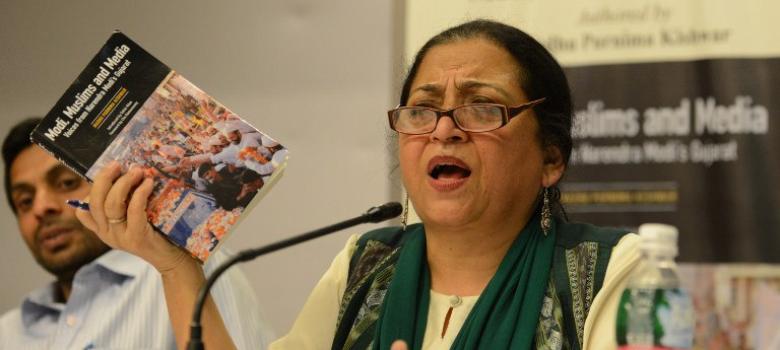
BJP's governance is questioned by Madhu Kishwar
http://mikeghouseforindia.blogspot.com/2015/11/bjps-governance-is-questioned-by-madhu.html
Madhu Kishwar is one of the biggest supporters of Modi in building his image over the years. To her, Modi is an avatar of God, like most of the devotees, she believed that Modi cannot make mistakes. Modi is blessed to have such blind following.
After the Delhi Debacle, she and few others spoke out, and now here is another article (below) that critiques Modi. I am not sure, if the BJP members will swallow this or go after her as they have done with others, there is a new culture of intolerance germinating in India among the members of Sangh Parivar, unchecked, it can grow big and tear down the social fabric of India.
She has written this article obviously to the zealots of BJP, and has passed on a lot of hot air as facts, which you see as you read through it, but has retained some integrity and that is the reason for my writing this note.
Modi is surrounded by the Chamchas, the sychophants who lie to him that everything is going great in his kingdom. She has said some of the things I have written before. Click on these article links after reading Madhu's article. Modi's Bubble and the Chamcha Culture, Modi on track to Cripple India, and many more articles.
Mike Ghouse
http://MikeGhouseforIndia.blogspot.com
Dr. Mike Ghouse is a community consultant, social scientist, thinker, writer, news maker and a speaker on Pluralism, Interfaith, Islam, politics, human rights, India, Israel-Palestine and foreign policy. He is committed to building cohesive societies and offers pluralistic solutions on issues of the day. More about him in 63 links at www.MikeGhouse.net and his writings are at www.TheGhousediary.com
# # #
Lessons From BJP’s Bihar Election Fiasco
Reams have already been written on the drubbing received by the BJP in the crucial Bihar assembly election.
Madhu Kishwar @madhukishwar
Commentary | 27-11-2015
Reams have already been written on the drubbing received by the BJP in the crucial Bihar assembly election. Let me attempt to add my own two cents’ worth to the series of postmortem reports that have been released since November 8.
Countdown to Debacle
Team Modi’s explanation for their drubbing in Bihar is that the caste arithmetic went against the BJP. But that could happen only because of the party’s own acts of omission and commission.
The writing was writ large on the wall from the word go, but Team Modi refused to pay heed to it in a timely manner. The main reason why Team Modi lost the Bihar election is that it avoided doing everything that had the potential to divide the opposition, and instead did everything to bring the mutually warring parties together. Determined action against political scamsters would have put the opposition in disarray. However, the failure to do so has created a Frankenstein monster that threatens to not only smash BJP but also destroy India.
People rallied behind Modi in 2014 cutting across caste, class, linguistic, regional, gender and even religious boundaries because of his promise of a corruption free India. Convinced that poverty, unemployment, increasing crime, mal-governance, etc., are all byproducts of the bureaucratic and political corruption institutionalized by previous regimes, the electorate passionately responded to the prospect of Congress Mukt Bharat because the party had become synonymous with scams, untrammeled loot of India and siphoning-off the country’s wealth to foreign shores.
modiPeople were persuaded that the Congress High Command – namely Sonia Gandhi and her family – were the fountainhead of this corruption. The Vadra-Priyanka land deals, the National Herald scam, the NDTV scam, Jet-Etihad deal, NSEL scam, the CWG scam were the proverbial tips of the iceberg.
Therefore, people were expecting Modi government to take strong action in order to bring to account the mafia that executed this loot. Had the Modi government ensured firm and determined action at least in the already exposed above mentioned financial scandals, it would have isolated the Congress Party from other opposition parties. It would also have sent the right signals to the likes to Lalu Yadav, Mayawati and Omar Abdullah.They would all be running for cover instead of launching a vicious campaign against the BJP in general and Modi in particular.
Senior BJP leader Subramanian Swamy kept warning the Modi government not to allow dilatory tactics in the open and shut National Herald case which had reached the concluding stage. Had Sonia and Rahul been convicted of fraud within the first few months of the Modi regime, the country would have celebrated the conviction. Now even if the court orders a well substantiated conviction, the Gandhi family will present themselves as victims of political vendetta.
Even the once despised Robert Vadra is now challenging Modi government’s belated inquiries into his land scam. It is beyond comprehension why the BJP government in Haryana humiliated and persecuted Ashok Khemka, the officer who exposed Robert Vadra’s shady deals, while rewarding all those officers who had assisted Vadra in acquiring huge tracts of land through devious means.
It is no less puzzling why PM Modi went back on his decision to bring an honest officer like Khemka to PMO aftyer announcing it publicly. That gave the impression of BJP government having cut a deal to protect the Gandhi family instead of letting the law take its own course. Like Lalu Yadav, Vadra too will become a hero of the secular brigade and be treated as a martyr if any action is taken against him now. Sensing the change in political equations post Bihar election both Rahul and Vadra are roaring like lions daring Modi to take action against them.
logoSimilarly, if right at the start of Modi’s tenure the scam ridden NDTV, which had become the most prominent symbol of partisan agendas of the media, had been brought to book on the strength of available evidence of financial frauds and hawala transactions collected by the Income Tax Department during the UPA tenure, the company would have faced imminent closure. That would have sent a clear message that the days of “paid media” were over.
Instead, Modi supporters were shocked to find that the BJP government was going out of its way to shield the tainted television network. The former Director of Enforcement Directorate Rajan S. Katoch known to be a P Chidambram flunkey was given an extension by the Finance Minister.
After the Bihar debacle, the Enforcement Directorate has issued a Rs. 2030 core notice to NDTV, but the action has been only under the relatively mild FEMA and not under the more stringent money laundering Act. This may prove to be a case of too little, too late. NDTV too will go scream vendetta and get loads of support from Modi baiters despite being caught in serious financial frauds.
The flip-flops over retrieving black money siphoned out of India, followed by an utterly ridiculous and draconian law for the ostensible purpose of bringing back the looted wealth topped with the final declaration that “there is no black money abroad, it’s all at home,” made the Modi government appear indecisive.
Veteran Supreme Court lawyer Ram Jethmalani kept shouting from roof tops that the German government had expressed willingness to provide to the Indian government the entire list of culprits holding secret foreign accounts abroad, if only the government made an official request for the same.
However, the BJP government’s steadfast refusal to secure the list from Germans put a shadow of doubt on it. The finance ministry may have buried the whole issue but it is alive in public memory as a major let down. So confident are Congressmen of being protected that they openly ridicule Modi for his false bravado in claiming to bring back India’s looted wealth.
Likewise, appointment of compromised officers as CBDT chairman, Central Vigilance Commissioner (CVC) and Chief Information Commissioner (CIC), despite their willing collaboration in the scams of the previous regime, created serious misgiving about the intentions of the Modi government.
While the prime minister seems to have put some of his own cabinet colleagues under strict watch in order to curb their propensity for corruption, letting his select ministers a free hand, despite their unsavory credentials along with the protective attitude towards the rogues of the previous regime, cast a pall of gloom among all those who had gravitated to him in the hope of ushering in a ‘clean India’ – both physically as well as morally.
The continuation and even promotion of rogue officers owing allegiance to the tainted UPA regime, gave a clear signal to the opposition that this government lacked the guts to confront and book the corrupt. This let down on the anti corruption drive, despite repeated warnings led, erstwhile close friends and supporter like Ram Jethmalani to actually go and address public meetings in Bihar in order to appeal to voters to defeat Modi and support Nitish Kumar because the PM had let down the country by protecting the crooks of the UPA regime.
sonia gandhiThe Opposition parties wouldn’t have dared to rally behind Sonia Gandhi nor would the latter have had the guts to act so belligerent had this government released the list of black money account holders that is suspected to include the name of Sonia Gandhi and other Congress bigwigs.
In short, a serious anti-corruption thrust, through due process would have divided the Opposition and brought many fence sitters come knocking at BJP’s door. This would have also kept the enthusiasm and idealistic dream of the youth alive that Modi government has the political will to free India of corruption. To top it all, Modi allowed the Opposition to put his government on the defensive by bringing in the highly ill-advised Land Acquisition Ordinance. The stigma of being anti-farmer along with the taint of being a shielder of scamsters enabled even Yadav to resurrect himself as a champion of democracy.
Walking into the “Intolerance” Trap
While avoiding all those actions that had the sure shot potential to divide the opposition, the BJP has done all it could to unite the opposition. The Narendra Modi of the highly-charged campaign for the 2014 general elections that brought BJP to power on its own steam seems an altogether different avatar from the one that fought the Bihar election of 2015. At that time, he talked like a statesman with his “Sabka saath, sabka vikas” (Together we stand, for development of all) slogan that fired the imagination of all those tired of the prevalent divisive politics of caste and religion.
While a divided opposition tried to run a shrill campaign projecting Modi as a divisive figure, the BJP’s prime ministerial aspirant was widely perceived as someone who would deliver for the general well-being of the nation if elected to the country’s supreme office. His own stellar track-record in Gujarat made him appear to be the best equipped to lift the country out of its third-world mindset to establish it as a world leader among the comity of nations.
One of the most awe inspiring moments of that historic campaign was the Hunkar (Battle Cry) Rally at Patna’s Gandhi Maidan. Modi had been warned by the security agencies about the high likelihood of bomb explosions. But he braved addressing that rally of over 500,000 even while bombs kept exploding as he was addressing the admiring audience.
Next day the police discovered several unexploded bombs under the very stage on which he stood. Modi knew he was standing in the jaws of death but spoke with such calm that no one in the charged gathering got a hint of what was happening right in the midst of that mammoth crowd. His main message to the audience reverberated with positive energy:
Hindus have a simple choice — either fight against poverty or fight against Muslims. Likewise, Muslims too have just one choice — fight against Hindus or fight against poverty.
Not surprisingly, he got a resounding endorsement for his “sabka saath, sabka vikas” vision, not just from Muslims and Hindus present in that rally but also from millions who watched Modi’s performance in that rally on TV.
In that situation, a divisive politician would have ranted against his opponents for having tried to sabotage his rally and get him assassinated. But Modi didn’t breathe a word about the explosions because he knew it could at once trigger communal mayhem since Muslims and JDU leaders would have been prime suspects. At the conclusion of the rally, Modi advised people to disburse peacefully, avoid stampede like situation so that each one reached home safe.
When people returned home and found out that the blasts had left six dead and over 80 injured, they realized the importance of the “reach home safely” message and his warning against divisive agendas. That day in the eyes of most people, Modi established his credentials as the man of the moment for India who would put an end to politically engineered sectarian strife.
However, after becoming PM, Modi seems to have forgotten his own deftly crafted script of inclusive politics. Not that his government did anything concrete against the Christians or Muslims. But as PM, Modi failed to define the terms of political discourse as he did during the run up to May 2014 election victory.
The humiliating defeat of the BJP in Delhi should have woken up the party that its survival in power depended on a divided opposition. To defeat BJP in Delhi, every party—whether regional or national—pitched in their bit to stop the Modi juggernaut by orchestrating and unleashing a high decibel smear campaign against BJP as a party that endangers religious minorities and is “intolerant” towards political dissenters. The hitherto divided parties had ganged up together and began a sinister campaign to put BJP on the defensive.
A couple of months prior to the Delhi assembly election, a series of alleged attacks on Christian institutions mysteriously happened in quick succession – in Delhi of all the places. This city hasn’t had a history of attacks on Christian community despite hosting a huge number of prominent Christian institutions.
To add fuel to fire, a Hindu Muslim riot was engineered in one of the trans-Yamuna colonies which the Aam Aadmi Party (AAP) was nursing as its special constituency. This enabled the combined Opposition along with Christian and Muslim leaders to build hysteria against Modi government alleging that these ‘attacks” are part of the “fascist” agenda of Modi government.
churchChurch-affiliated bodies and the Delhi-centric English TV and print media put the onus on “extremist right wing Hindu organizations” which are cleverly projected as offspring of the BJP even when they have been propped up by the Congress Party.
Police investigations soon exposed that those isolated acts of vandalism had no religious overtones.
In the first of these six alleged attacks in December 2014, a fire damaged St. Sebastian Church in Dilshad Garden. The Special Investigative Team (SIT) exposed that the fire was caused by faulty electrical wiring in the Church. The SIT report to the Home Ministry emphatically stated that, “There was no attempt made by anyone to trigger off a religious hate crime and neither was it the result of polarization on religious lines. It was a clear cut case of short circuit which was blown out of proportion by a section of people.”
http://mikeghouseforindia.blogspot.com/2015/11/bjps-governance-is-questioned-by-madhu.html
Madhu Kishwar is one of the biggest supporters of Modi in building his image over the years. To her, Modi is an avatar of God, like most of the devotees, she believed that Modi cannot make mistakes. Modi is blessed to have such blind following.
After the Delhi Debacle, she and few others spoke out, and now here is another article (below) that critiques Modi. I am not sure, if the BJP members will swallow this or go after her as they have done with others, there is a new culture of intolerance germinating in India among the members of Sangh Parivar, unchecked, it can grow big and tear down the social fabric of India.
She has written this article obviously to the zealots of BJP, and has passed on a lot of hot air as facts, which you see as you read through it, but has retained some integrity and that is the reason for my writing this note.
Modi is surrounded by the Chamchas, the sychophants who lie to him that everything is going great in his kingdom. She has said some of the things I have written before. Click on these article links after reading Madhu's article. Modi's Bubble and the Chamcha Culture, Modi on track to Cripple India, and many more articles.
Mike Ghouse
http://MikeGhouseforIndia.blogspot.com
Dr. Mike Ghouse is a community consultant, social scientist, thinker, writer, news maker and a speaker on Pluralism, Interfaith, Islam, politics, human rights, India, Israel-Palestine and foreign policy. He is committed to building cohesive societies and offers pluralistic solutions on issues of the day. More about him in 63 links at www.MikeGhouse.net and his writings are at www.TheGhousediary.com
# # #
Lessons From BJP’s Bihar Election Fiasco
Reams have already been written on the drubbing received by the BJP in the crucial Bihar assembly election.
Madhu Kishwar @madhukishwar
Commentary | 27-11-2015
Reams have already been written on the drubbing received by the BJP in the crucial Bihar assembly election. Let me attempt to add my own two cents’ worth to the series of postmortem reports that have been released since November 8.
Countdown to Debacle
Team Modi’s explanation for their drubbing in Bihar is that the caste arithmetic went against the BJP. But that could happen only because of the party’s own acts of omission and commission.
The writing was writ large on the wall from the word go, but Team Modi refused to pay heed to it in a timely manner. The main reason why Team Modi lost the Bihar election is that it avoided doing everything that had the potential to divide the opposition, and instead did everything to bring the mutually warring parties together. Determined action against political scamsters would have put the opposition in disarray. However, the failure to do so has created a Frankenstein monster that threatens to not only smash BJP but also destroy India.
People rallied behind Modi in 2014 cutting across caste, class, linguistic, regional, gender and even religious boundaries because of his promise of a corruption free India. Convinced that poverty, unemployment, increasing crime, mal-governance, etc., are all byproducts of the bureaucratic and political corruption institutionalized by previous regimes, the electorate passionately responded to the prospect of Congress Mukt Bharat because the party had become synonymous with scams, untrammeled loot of India and siphoning-off the country’s wealth to foreign shores.
modiPeople were persuaded that the Congress High Command – namely Sonia Gandhi and her family – were the fountainhead of this corruption. The Vadra-Priyanka land deals, the National Herald scam, the NDTV scam, Jet-Etihad deal, NSEL scam, the CWG scam were the proverbial tips of the iceberg.
Therefore, people were expecting Modi government to take strong action in order to bring to account the mafia that executed this loot. Had the Modi government ensured firm and determined action at least in the already exposed above mentioned financial scandals, it would have isolated the Congress Party from other opposition parties. It would also have sent the right signals to the likes to Lalu Yadav, Mayawati and Omar Abdullah.They would all be running for cover instead of launching a vicious campaign against the BJP in general and Modi in particular.
Senior BJP leader Subramanian Swamy kept warning the Modi government not to allow dilatory tactics in the open and shut National Herald case which had reached the concluding stage. Had Sonia and Rahul been convicted of fraud within the first few months of the Modi regime, the country would have celebrated the conviction. Now even if the court orders a well substantiated conviction, the Gandhi family will present themselves as victims of political vendetta.
Even the once despised Robert Vadra is now challenging Modi government’s belated inquiries into his land scam. It is beyond comprehension why the BJP government in Haryana humiliated and persecuted Ashok Khemka, the officer who exposed Robert Vadra’s shady deals, while rewarding all those officers who had assisted Vadra in acquiring huge tracts of land through devious means.
It is no less puzzling why PM Modi went back on his decision to bring an honest officer like Khemka to PMO aftyer announcing it publicly. That gave the impression of BJP government having cut a deal to protect the Gandhi family instead of letting the law take its own course. Like Lalu Yadav, Vadra too will become a hero of the secular brigade and be treated as a martyr if any action is taken against him now. Sensing the change in political equations post Bihar election both Rahul and Vadra are roaring like lions daring Modi to take action against them.
logoSimilarly, if right at the start of Modi’s tenure the scam ridden NDTV, which had become the most prominent symbol of partisan agendas of the media, had been brought to book on the strength of available evidence of financial frauds and hawala transactions collected by the Income Tax Department during the UPA tenure, the company would have faced imminent closure. That would have sent a clear message that the days of “paid media” were over.
Instead, Modi supporters were shocked to find that the BJP government was going out of its way to shield the tainted television network. The former Director of Enforcement Directorate Rajan S. Katoch known to be a P Chidambram flunkey was given an extension by the Finance Minister.
After the Bihar debacle, the Enforcement Directorate has issued a Rs. 2030 core notice to NDTV, but the action has been only under the relatively mild FEMA and not under the more stringent money laundering Act. This may prove to be a case of too little, too late. NDTV too will go scream vendetta and get loads of support from Modi baiters despite being caught in serious financial frauds.
The flip-flops over retrieving black money siphoned out of India, followed by an utterly ridiculous and draconian law for the ostensible purpose of bringing back the looted wealth topped with the final declaration that “there is no black money abroad, it’s all at home,” made the Modi government appear indecisive.
Veteran Supreme Court lawyer Ram Jethmalani kept shouting from roof tops that the German government had expressed willingness to provide to the Indian government the entire list of culprits holding secret foreign accounts abroad, if only the government made an official request for the same.
However, the BJP government’s steadfast refusal to secure the list from Germans put a shadow of doubt on it. The finance ministry may have buried the whole issue but it is alive in public memory as a major let down. So confident are Congressmen of being protected that they openly ridicule Modi for his false bravado in claiming to bring back India’s looted wealth.
Likewise, appointment of compromised officers as CBDT chairman, Central Vigilance Commissioner (CVC) and Chief Information Commissioner (CIC), despite their willing collaboration in the scams of the previous regime, created serious misgiving about the intentions of the Modi government.
While the prime minister seems to have put some of his own cabinet colleagues under strict watch in order to curb their propensity for corruption, letting his select ministers a free hand, despite their unsavory credentials along with the protective attitude towards the rogues of the previous regime, cast a pall of gloom among all those who had gravitated to him in the hope of ushering in a ‘clean India’ – both physically as well as morally.
The continuation and even promotion of rogue officers owing allegiance to the tainted UPA regime, gave a clear signal to the opposition that this government lacked the guts to confront and book the corrupt. This let down on the anti corruption drive, despite repeated warnings led, erstwhile close friends and supporter like Ram Jethmalani to actually go and address public meetings in Bihar in order to appeal to voters to defeat Modi and support Nitish Kumar because the PM had let down the country by protecting the crooks of the UPA regime.
sonia gandhiThe Opposition parties wouldn’t have dared to rally behind Sonia Gandhi nor would the latter have had the guts to act so belligerent had this government released the list of black money account holders that is suspected to include the name of Sonia Gandhi and other Congress bigwigs.
In short, a serious anti-corruption thrust, through due process would have divided the Opposition and brought many fence sitters come knocking at BJP’s door. This would have also kept the enthusiasm and idealistic dream of the youth alive that Modi government has the political will to free India of corruption. To top it all, Modi allowed the Opposition to put his government on the defensive by bringing in the highly ill-advised Land Acquisition Ordinance. The stigma of being anti-farmer along with the taint of being a shielder of scamsters enabled even Yadav to resurrect himself as a champion of democracy.
Walking into the “Intolerance” Trap
While avoiding all those actions that had the sure shot potential to divide the opposition, the BJP has done all it could to unite the opposition. The Narendra Modi of the highly-charged campaign for the 2014 general elections that brought BJP to power on its own steam seems an altogether different avatar from the one that fought the Bihar election of 2015. At that time, he talked like a statesman with his “Sabka saath, sabka vikas” (Together we stand, for development of all) slogan that fired the imagination of all those tired of the prevalent divisive politics of caste and religion.
While a divided opposition tried to run a shrill campaign projecting Modi as a divisive figure, the BJP’s prime ministerial aspirant was widely perceived as someone who would deliver for the general well-being of the nation if elected to the country’s supreme office. His own stellar track-record in Gujarat made him appear to be the best equipped to lift the country out of its third-world mindset to establish it as a world leader among the comity of nations.
One of the most awe inspiring moments of that historic campaign was the Hunkar (Battle Cry) Rally at Patna’s Gandhi Maidan. Modi had been warned by the security agencies about the high likelihood of bomb explosions. But he braved addressing that rally of over 500,000 even while bombs kept exploding as he was addressing the admiring audience.
Next day the police discovered several unexploded bombs under the very stage on which he stood. Modi knew he was standing in the jaws of death but spoke with such calm that no one in the charged gathering got a hint of what was happening right in the midst of that mammoth crowd. His main message to the audience reverberated with positive energy:
Hindus have a simple choice — either fight against poverty or fight against Muslims. Likewise, Muslims too have just one choice — fight against Hindus or fight against poverty.
Not surprisingly, he got a resounding endorsement for his “sabka saath, sabka vikas” vision, not just from Muslims and Hindus present in that rally but also from millions who watched Modi’s performance in that rally on TV.
In that situation, a divisive politician would have ranted against his opponents for having tried to sabotage his rally and get him assassinated. But Modi didn’t breathe a word about the explosions because he knew it could at once trigger communal mayhem since Muslims and JDU leaders would have been prime suspects. At the conclusion of the rally, Modi advised people to disburse peacefully, avoid stampede like situation so that each one reached home safe.
When people returned home and found out that the blasts had left six dead and over 80 injured, they realized the importance of the “reach home safely” message and his warning against divisive agendas. That day in the eyes of most people, Modi established his credentials as the man of the moment for India who would put an end to politically engineered sectarian strife.
However, after becoming PM, Modi seems to have forgotten his own deftly crafted script of inclusive politics. Not that his government did anything concrete against the Christians or Muslims. But as PM, Modi failed to define the terms of political discourse as he did during the run up to May 2014 election victory.
The humiliating defeat of the BJP in Delhi should have woken up the party that its survival in power depended on a divided opposition. To defeat BJP in Delhi, every party—whether regional or national—pitched in their bit to stop the Modi juggernaut by orchestrating and unleashing a high decibel smear campaign against BJP as a party that endangers religious minorities and is “intolerant” towards political dissenters. The hitherto divided parties had ganged up together and began a sinister campaign to put BJP on the defensive.
A couple of months prior to the Delhi assembly election, a series of alleged attacks on Christian institutions mysteriously happened in quick succession – in Delhi of all the places. This city hasn’t had a history of attacks on Christian community despite hosting a huge number of prominent Christian institutions.
To add fuel to fire, a Hindu Muslim riot was engineered in one of the trans-Yamuna colonies which the Aam Aadmi Party (AAP) was nursing as its special constituency. This enabled the combined Opposition along with Christian and Muslim leaders to build hysteria against Modi government alleging that these ‘attacks” are part of the “fascist” agenda of Modi government.
churchChurch-affiliated bodies and the Delhi-centric English TV and print media put the onus on “extremist right wing Hindu organizations” which are cleverly projected as offspring of the BJP even when they have been propped up by the Congress Party.
Police investigations soon exposed that those isolated acts of vandalism had no religious overtones.
In the first of these six alleged attacks in December 2014, a fire damaged St. Sebastian Church in Dilshad Garden. The Special Investigative Team (SIT) exposed that the fire was caused by faulty electrical wiring in the Church. The SIT report to the Home Ministry emphatically stated that, “There was no attempt made by anyone to trigger off a religious hate crime and neither was it the result of polarization on religious lines. It was a clear cut case of short circuit which was blown out of proportion by a section of people.”
In a second incident in Jasola it was alleged that a group of miscreants
threw a stone and shattered a windowpane. The police investigation revealed that
it was due to a group of kids playing outside, which resulted in a stone landing
inside the church. There was no evidence as yet of any communal angle.
The third incident in Rohini, in which the Christmas crib was charred, was
determined by the police to be the result of an electrical short circuit.
The fourth incident in Vikaspuri, in which a small group of men allegedly
broke the glass windows of a church and toppled the statue of Mother Mary kept
in a glass enclosure outside the Church, turned out to be the result of a
drunken dare. What’s more, they were caught on CCTV and arrested shortly
thereafter by the police and have confessed to the crime. Again, there was no
evidence whatsoever of a communal angle.
The fifth incident in Vasant Kunj, was found to be a case of minor
burglary.
The sixth incident in Holy Child School, Vasant Vihar involved case of
theft of Rs 8,000 by an insider. But it was blown up as yet another “attack on
Christians.”
Even in an open and shut case like the Vikaspuri incident in which the
perpetrators were caught and confessed to the drunken dare, Delhi Archbishop
Anil Cuoto maintained in the face of the evidence that he was dissatisfied with
the police explanation, without explaining how the CCTV footage and the
perpetrators’ own confession go against his version.
Even the high-profile case of the alleged rape of a 71-year-old nun at a
convent in West Bengal turned out to be the handiwork of a Bangladesh-based gang
in collusion with employees of that convent. Ironically even though the attack
itself took place under super secular chief minister Mamta Bannerjee’s regime,
the blame of it came directly on Modi as though he had personally hired the
attackers.
In the case of a petty theft in Holy Child School, HRD Minister Smriti
Irani personally rushed to the school give assurance of quick action. But in
effect it lent credence to the “attack” theory. PM Modi also called the Police
Commissioner and gave strict instructions to set up a special monitoring system
to protect churches. All these seemed like defensive measures and only
emboldened BJP baiters.
Although each one of them were incidents of petty crime or minor accidents,
the Indian media led a hysterical campaign to tar India as a place of “growing
intolerance.” This chorus by respected leftist and “liberal” intellectuals was
avidly picked up by the international media which in any case delights in
bashing “Hindu India.”
The absurdity of this charge becomes more obvious when you consider the
comparative figures for similar or even more serious incidents involving Hindu
temples in the same period.
As per police records, 206 temples, 30 gurudwaras and three churches (out
of some 200 or more churches in Delhi) and 14 mosques were burgled during 2014.
And such crimes didn’t mysteriously start to occur in May 2014 after the BJP’s
victory — as with other crimes, they routinely occur every year in Delhi as the
data shows.
Despite the facts pointing in one direction, church leaders and
commentators, both in the domestic and foreign media who parrot their line,
continued to insist that there’s a pattern to the incidents, the motivation is
communal, and the BJP or affiliated groups are the key culprits in promoting
“intolerance”.
Similarly, a couple of instances of reconversion of a small group of
Muslims to Hinduism accompanied by a few statements in favour of “Ghar Wapsi” by
stray members of Sangh Parivar – came to be used as ultimate proof of BJP
government endangering religious minorities. By contrast, wholesale conversions
to Christianity in several regions of India through means fair and foul and
systematic change in the demographic profile of border states due to large scale
illegal Bangladeshi migrants pushing out Hindus from their ancestral villages is
not an issue with our “sickularists”. The lackluster approach of the Modi
government in handling this duplicity provided its opponents with yet another
stick to browbeat it with.
On February 5, just two days before the Delhi election, when prohibitory
orders were well in place against holding any unlawful assembly, in pursuance of
the Central Election Commission (CEC) guidelines, a major demonstration to
condemn “religious intolerance” of BJP government was staged outside the Sacred
Heart Cathedral in Delhi’s Lutyens zone.
Interestingly several leaders of the AAP that was trying to stage a second
coming after a disastrous first term in the city state, prominently took part in
it. The Delhi Police managed to break the demonstration without any untoward
incident. However, by that afternoon, the media was widely reporting how the
cops had prevented a democratic protest against “religious intolerance” and had
“bundled (protestors) into waiting buses”. This became yet another proof that
Modi regime poses a menace to India’s democracy.
All this mischief could have been nipped in the bud if only the government
had grabbed the bull by the horns and published a white paper to expose the
sinister purpose behind misleading reports of attacks on Christian institutions.
In addition, it should have issued a stern warning to all those spreading
misinformation that they would be booked under section 153 & 153A of IPC for
vitiating social atmosphere and spreading disharmony among religious groups. A
couple of such convictions would have put the fear of law in the minds of those
willfully spreading disinformation and halted the tsunami of hate campaign that
soon followed.
But since Modi government appeared defensive it enabled the national media
and Opposition parties to tar it internationally. Global networks of the Church
played on the hysteria to the hilt and Modi-ruled India was declared as a place
that made life unsafe for Christians and Muslims.
The frenzy thus generated emboldened, Modi’s “good friend” Barack Obama to
give a stiff sermon to the PM on the need to curb the growing religious strife
and intolerance. This set the “intolerance” discourse in stone with BJP
government haplessly taking all the drubbing.
The very same forces that had worked hard to bring Modi down as Gujarat CM
and prevent his rise to power as PM were back in full force. But the Modi
government remained smug in the belief that his popularity wave would conquer
all as in May 2014. When the results of the Delhi poll were out, the BJP, the
strongest contender to Delhi was all but routed by a mere two-year old AAP. Not
surprisingly, “church attacks” stopped as soon as the BJP was trounced in
Delhi.
The biggest take away from the Delhi poll was that a united opposition
aided and abetted by the intellectual fire power of the “secular” gang in the
national media could easily defeat the BJP. And yet no lesson was learnt.
Instead of winning over sections of the Opposition parties, Modi allowed
them to consolidate a united front against the NDA government. In the run-up to
Delhi elections, Modi government at least tried to defend itself against false
charges, however ineffectively, but in the run up to Bihar election, Modi
himself fell in every trap laid out for him and his party.The most inexplicable
act of omission was with regard to the September 28 lynching of Mohammad Akhlaq
in Dadri (Uttar Pradesh) allegedly on account of beef eating.
All that Modi had to do was to issue a strong statement saying that though
the cow is indeed sacred for his party but human life is no less sacred for BJP.
Therefore, anyone harming another human being under the guise of cow protection
would be dealt with sternly.
In addition, Modi should have conveyed a strong message to Akhilesh Yadav
to expedite the investigation and punish the guilty. BJP should have gone on the
offensive against SP government for failing to book culprits.
Instead the mysterious silence of Modi on this issue enabled his opponents
to attribute it to Modi’s complicity in encouraging mob action. Even as the
sinister plot behind the Dadri killing is slowly unraveling and the Samajwadi
Party has failed to charge sheet the accused, Modi’s mishandling of this
incident caused irreparable damage to the BJP’s image.
kalburgiThis was followed by the murder of “rationalist” writer MM Kalburgi
in Karnataka. Even before police began investigations, the murder was attributed
of BJP. Although it took place in a Congress ruled state, no one grilled the
Congress chief minister for failing to nab the culprits.
Instead the target was Narendra Modi himself whose steadfast silence on the
issue was exploited to build a case that his party men were guilty of the crime.
Similarly, the media has earlier insinuated the participation of “hard line
Hindutva groups” in the murder of rationalists Narendra Dhabolkar, and Govind
Pansare in Maharashtra.
Dhabolkar was killed when a Congress-led coalition government was in power
in Maharashtra. What is interesting is the fact that Dhabolkar once vehemently
argued against the canonization of Mother Teresa by the Vatican Church, while
Pansare had been highly critical of some very powerful god men, some with close
Congress links. Till date their killers have not been caught but the Congress
governments have not been called to account and the blame is put squarely at
BJP’s doorstep.
The astute manner in which Congress and Left parties got several past
winners of Sahitya Akademi awards to return their trophies as a mark of protest
against “rising tide of intolerance” in India under PM Modi should have come as
a wake-up call.
Although several commentators in the mainstream and social media called the
political credentials of the protesting artists to doubt, the drama got wide
coverage in the national and international media. The Award Wapsi Brigade may
not have carried any electoral clout in Bihar but they certainly succeeded in
building a negative aura around BJP and Modi and gave the much needed boost to
the morale of the newly united opposition parties. Even the tainted and
convicted Lalu Yadav strutted around like a proud peacock because the media
treated him like a prized warrior in their desperate bid to defeat Modi.
This disgraceful drama could not have been orchestrated with such finesse
had the government booked those spreading false information in the run up to
Delhi elections.
To use an analogy, a now united opposition kept throwing banana peels in
the path of the BJP, and the party for its own part, kept unfailingly slipping
on them more by their acts of omission than any serious harm they did.
Undervaluing Intellectual Firepower
Worse still, instead of defusing the hate campaign, the Modi government
added fuel to the fire by appointing an undistinguished Bollywood actor and
producer as the director of Film and Television Institute (FTII), Pune, a strong
bastion of leftist film makers.
So inappropriate was this choice that even long time BJP supporters were
left aghast. True, the left would have raised hell no matter who the BJP
government appointed because they cannot tolerate the loss of their monopoly
over key positions of power after the defeat of Congress Party.
But by handpicking utterly inappropriate persons for key portfolios in
academic and cultural institutions, the BJP gives the message that it is both
talent deficit and talent averse. This makes it more vulnerable because the
enormous intellectual talent pool that gravitated towards Modi in the run up to
May 2014, election feels repelled by the party’s low grade choices.
The Modi of the 2014 Lok Sabha elections had created disarray in the
opposition by putting them all on the defensive. But the Modi of the 2014 Delhi
elections as well as the 2015 Bihar elections was fighting a defensive battle
against a combined opposition because the agenda was set by his enemies.
Just as church attacks ceased the moment the BJP was defeated in Delhi so
also the beef related violence vanished along with award wapsi campaign as soon
as the BJP was trounced in Bihar.
The only unifying glue for the opposition is a crass variety of
“secularism”, these days aptly described as “sickularism.” And Modi himself
supplied them this glue in such an abundant measure that even sworn enemies like
Nitish Kumar and Lalu Yadav became firm allies.
Fatal Flaw of the BJP
A long standing fatal flaw of the BJP is that while it puts great emphasis
on the hardware of politics–namely electoral mobilization through dedicated
party cadre, they show little awareness of the need to develop high-quality
software of politics, which comes from cultivating intellectual firepower and
academic talent which plays a crucial role in defining the political narrative
of the day.
It’s regrettable that Modi has allowed the Congress and Left monopoly in
this regard to stay intact. The Congress party deftly used the education and
culture ministries to garner a national and international network of
intellectual warriors. Nurul Hasan as Indira Gandhi’s Education Minister laid
the foundations of this empire while Arjun Singh, Kapil Sibal and others added
further reinforcements to that citadel by extending their net of patronage far
and wide among left oriented intellectuals around one point agenda – make them
full time warriors against the BJP.
Their discourse has made the BJP synonymous with “fascist” politics, while
washing away the blot of thousands of caste and communal riots from the face of
the Congress. The BJP has never dared challenge this defamation either through
courts or by countering it with its own intellectual firepower.
If one looks at the appointments to key positions in institutions, it
appears that the Modi government has communicated disdain for the world of
academia and intellectuals or at best is unaware of the importance of these
institutions.
Today, Congress appointees openly sneer at Modi government’s talent deficit saying they have none to replace us. The BJP government doesn’t seem to realize that moral legitimacy of regimes is created by well-honed intellectuals.
Even his Skill India Mission cannot succeed if it does not have solid intellectual foundations. No country can become a global power in the 21st century by merely training good plumbers and electricians. Universities and other knowledge hubs act as shapers of public discourse and political narratives, a game that the BJP is losing fast.
oropAnother blunder of Team Modi was the inexplicable delay in implementing the One Rank One Pension promise which led the army veterans—once avid supporters of Modi—to sit on a 70-day long dharna and hunger strike against the BJP government. Many of them actively campaigned against BJP in the Bihar election.
Finally, it didn’t help that the BJP’s campaign in Bihar sidelined local leaders who were rendered invisible and inconsequential during the election campaign. The election team airlifted outsiders to go and camp in Bihar while local leaders were denied any meaningful role. There was widespread anger against arbitrary choice of candidates, especially those with criminal track records. Today it is the BJP rank and file that is accusing “the party with a difference” of having become “a party with arrogance”.
Bihar is the last wake up call for PM Modi. He better realize that failure is not an option for him since the people of India have reposed enormous faith in him to deliver a model of governance and economic growth that would help India gain a respectful place in the comity of nations.
The above article is published on 11/27/15 at http://indiafacts.co.in/lessons-from-bjps-bihar-election-fiasco/
(These are the author’s personal views)
Madhu Purnima Kishwar is a professor at Centre for the Study of Developing Societies and founder of Manushi–a human rights/ women’s rights organization. Among others, she is the author of “Modi, Muslims and Media” ( Manushi Publications), Zealous Reformers, Deadly Laws, (Sage Publishers), Deepening Democracy–Challenges of Governance & globalization in India ( Oxford University Press), Off the Beaten Track: Essays on Gender Issues ( Oxford University Press), Religion at the Service of Nationalism & Other Essays ( Oxford University Press).