HOME | ABOUT US | Speaker | Americans Together | Videos | www.CenterforPluralism.com | Please note that the blog posts include my own articles plus selected articles critical to India's cohesive functioning. My articles are exclusively published at www.TheGhouseDiary.com You can send an email to: MikeGhouseforIndia@gmail.com


Showing posts with label Bollywood film. Show all posts

Saturday, February 3, 2018

Padmaavat - story behind the story, when fiction becomes reality.

So much hell is raised in India about the film as though it is real, it was a story written some 500 years ago and it has become a reality to many, particularly a group from among the Rajputs. Did anyone tell them that, arey baba a film hai, kyoon pareshan ho rahe ho?

Please do read two other accounts of the film.

Padmaavat: Where are the Muslim protesters by Aijaz Zaka Syedhttp://mikeghouseforindia.blogspot.com/2018/01/padmaavat-where-are-muslim-protesters.html


And one of the best articles on Misogyny and Gender Pluralism by Swara Bhasker
http://centerforpluralism.com/padmaavat-a-film-is-reduced-to-a-vagina/
I would be pleased to share more stories, but substantial and worth reading at this blog.

Mike Ghouse
http://MikeGhouseforIndia.blogspot.com

Courtesy - Daily Times


When fiction becomes reality

The current controversary in India about the Bollywood Hindi film, Padmavati, has brought a new spotlight on a relatively lesser-known Muslim sufi poet, Malik Muhammad Jayasi, on whose epic poem, Padmavat, the film is based on.
Jayasi was born more than five centuries ago in a small town in the district of Amethi in present-day Uttar Pradesh, India. Definitive details about his life are shrouded in the mists of time. However, he is believed to have lived during 1477 to1542 AD, when North India was ruled by late Lodhi and early Mughal dynasties. He was brought up in the old sufi traditions, had a religious upbringing, an ascetic life style and had studied Sanskrit grammar and linguistics under Hindu teachers. A century after his death, Jayasi acquired the status of a sufi saint and his tomb near Amethi has become a pilgrimage site, drawing people of all faiths seeking blessings and spiritual fulfilment.
A prolific author, Jayasi is reputed to have created 25 works of literature, most of which are not extant. He wrote poetry in his native Owadhi language as well as Persian, drawing inspiration from Muslim sufi saints and ancient Hindu scriptures and writings of Kabir Das.  His most famous poem, Padmavat, written probably in Persian in 1540 just before his death, narrates a fictional account of the siege in 1303 AD of the Chittorgarh fort in the present-day Rajasthan state, India, by Sultan Alauddin Khilji (1250-1316). The story has several versions. According to one, the Sultan had heard stories of the exceptional beauty of Padmavati, princess of Singhalese, or Sri Lankan origin, who was married to the Rajput ruler of Chittorgarh, Raja Ratansen, (also named Ratnasimha or Ratan Singh).The Sultan enamored by reports of her beauty and accomplishments was determined to possess her.
While the story of Padmavati may not be authentic, in today’s climate in India legends involving past Muslim rulers assume a perception of reality. Some partisan groups in India are trying to rewrite the history, resurrecting millennia-old historic grievances and injustices, real or imagined, to create a negative narrative about Muslim rulers
On Ratansen’s refusal to surrender her, the Sultan sent forces to capture Chittorgarh and Padmavati. The siege of the impregnable fort lasted for months, until a peace agreement was negotiated. Under its conditions, the Sultan was permitted to visit the fort and have a glimpse of the fabled queen, which, alas, did nothing to attenuate his passion for her. He captured Raja Ratansen, and brought him back to Delhi as a prisoner.
Ratansen’s imprisonment, however, did not last long. Using some ingenious tricks, Rajput warriors were able to free him and bring him back to Chittorgarh. That, nevertheless, was not the end of the Raja’s troubles. He was slain in a dual with another rival, who was also seeking Padmavati. The queen was so devastated by the loss of her husband that she threw herself on his funeral pyre, committing Sati, following the ancient Hindu practice.
The Sultan’s armies, meanwhile, renewed their siege of Chittorgarh. The Rajput fighters, certain of defeat, came out for a final do-or-die battle and perished, while the women folk fearful of falling in the hands of the Muslim army committed mass self-immolation (Jauhar), also an old Rajput custom. [Sati was eventually eradicated in India by the British. The then Governor-General Lord William Bentinck, who described the practice as “revolting to the feelings of human nature,” outlawed it by law on December 4, 1829.]
Jayasi ends his allegory on a poignant note, rendering a powerful lesson in the futility of all pyrrhic conquests. As he picked up the ashes of Ratansen and Padmavati, the Sultan was full of remorse, concluding that, “The human desire is insatiable, permanent, but this world is illusory and transient. Man continues to have insatiable desire, till life is over and he reaches his grave.”
Although the Padmavati legend has fascinated generations, any evidence about its authenticity is lacking. Jayasi, who wrote the poem nearly two-and-half centuries after the battle of Chittorgarh, emphasized that the story was an allegory, entirely made up by him. His assertion is also supported by absence of any mention of it in contemporary historic documents, such as Khaza’inul-Futuh’ (the treasures of victory) authored by Amir Khusrau, who was alive during the reign of Alauddin Khilji.  Similarly, the medieval historian, Ziauddin Barani, who lived from 1285 to 1357 AD, wrote a comprehensive treatise of the Delhi Sultanate (Tarikh-i-Firuz Shahi), also made no reference to the legend nor of the self-immolation, (Jauhar) of the women in Chittorgarh. Only Muhammad Qasim Firishta in his Tarkih e Firishta, completed more than three centuries after the alleged event, gave a sketchy account of the episode, probably borrowed from Jayasi’s earlier work..
Immortalized by Jayasi, the character of Padmavati has over the years been the subject of a number of plays and movies, the latest being the Indian Hindi film, Padmavati, directed by Sanjay Leela Bhansali. The director has displayed a special talent for making movies based in historical fiction, amply enriched with pageantry and grandiosity. Padmavati, however, has become a problem for him. Even before it was released, it ignited a storm of opposition, and the director was subjected to personal and verbal abuse. It is not known how faithfully the film reflects Jayasi’s script; however, India’s Central Board of Film Certification, after much hesitancy finally approved its release, scheduled for late January 2018. Importantly, the Indian Supreme Court recently overruled all injunctions and permitted its general release.
The reasons for opposition to the film by some groups are not entirely apparent, especially since only a few have seen it. Whatever information has leaked out suggests that it presents Sultan Alauddin Khilji in an unflattering light, as a lustful invader, who captured the fort and committed atrocities against the population, while the fictional Maharani Padmavati emerges as a heroic victim, who sacrificed her life to save her honor. This portrayal of the two protagonists may be consistent with Jayasi’s own narrative as presented in his epic poem. And, that may be the reason why there has been only muted opposition to the film from the Bhartiya Janata Party (BJP) supporters in India. The main opposition seems to have come from some members of Rajput community, Rajput Karni Sena.  It was rumored, mistakenly, that the film included a scene in which the Sultan was shown making love to Rani Padmavati. The producers have denied emphatically that any such scene was included. In fact, the lead actors, Ranveer and Deepika, who play the roles of Alauddin and Padmavati, do not even appear together anywhere in the film.
While the story of Padmavati may not be authentic, in today’s climate in India legends involving past Muslim rulers assume a perception of reality. Some partisan groups in India are trying to rewrite the history, resurrecting millennia-old historic grievances and injustices, real or imagined, to create a negative narrative about Muslim rulers. Contrary to the depiction, Sultan Alauddin Khilji was one of the most talented rulers of medieval India, who is credited with saving the country from the Moghul onslaughts that had wasted countries of Central Asia in the 13th and 14th centuries.
It may be beneficial to remember that in the Medieval times all rulers, Muslim and non-Muslim, exercised absolute power, and were accountable to no one. Thus, their policies and actions need to be judged in the context of the norms prevailing at the time.
The writer is a Health Scientist Administrator at the National Institutes of Health, Bethesda, Maryland and an Assistant Professor at the Harvard Medical School with a PhD from the University of Birmingham, England

Wednesday, January 31, 2018

Padmaavat: Where are Muslim protesters?


In the article appended below, Aijaz Zaka Syed wrote, "What really worries me — as it should every Indian who loves his/her country and desires its wellbeing is the hate and ill will all this is generating between the Hindus and Muslims. Being taught those textbooks and perpetually bombarded with hate in films and on television, even Muslim children would grow up hating their own ancestors."
This is a real concern, indeed, this is precisely the experience of Native Americans. In one of our Programs of Holocaust and Genocides, we focus on Native American Genocides, and one of the young men says similar words.  Watch this at 7th minute in the video https://youtu.be/uneRYgYfgWI

As Muslim Indians, we care about the state of our nation and will do everything to restore her back to our pluralistic traditions, where we respected the otherness of others and accepted the God-given the uniqueness of each one of us. If you cannot respect a fellow Indian, what will you respect then? Let everyone live his own life and you live yours. 


One of the comments that reflect the thoughts of many a Muslims came from Safia Faruqi of Lucknow, "We are uninterested in how Khilji is portrayed. We do not identify with any of these kings. We are neither proud of them nor apologetic about them. We should, in fact, stay away from such meaningless things. We would be playing into their hands and furthering the agenda of polarization." 

In a message to my fellow Indians, I had posted a question;  
"Should Muslims condemn the wrongdoers who happened to be Muslim Kings? After all, they did not do any good for Islam or Muslims except fulfilling their own greed like any other king of the time."

Another good response came from Tariq Farooqi, who wrote, "
So what should Indian Muslims do?  There is no need to defend these kings as they were defending their empires and not representing Islam or Islamic virtues.  Muslim masses suffered as poorly as their Hindu counterparts.  While they could point to historians in stating that the movie is a fictional account of love between a king and a fictional woman, the Bhakts have taken over and started burning theaters and damaging surrounding infrastructure.  We can stay away from this madness and condemn the cowardly and unbecoming violence of the mobs."


Indeed, I am working on pulling Indians of different hues together and develop a working program to build a cohesive India, where every Indian takes pride in who he or she is.
Mike Ghouse 
Padmaavat: Where are Muslim protesters?
Courtesy - Saudi Gazette
If anyone should be going ballistic over Padmavati — sorry, Padmaavat — the spectacular cinematic tribute to Rajput valor (obviously decent, virtuous Hindus) and crass demonization of Emperor Alauddin Khilji (the archetype of marauding, meat-gorging, horny invaders!), it is Muslims. Why’s Karni Sena, pray, going on the rampage, burning down multiplexes and malls and turning the whole country upside down?

This when bowing to the diktats of these defenders of Hindu pride, the filmmaker has already changed the title from ‘Padmavati’ to ‘Padmaavat’. It was only after the Supreme Court intervened that the film got released after repeated delays albeit it remains a ‘no show’ in many northern states.

Those who have watched the film found it so utterly reverential to the Rajputs and so demeaning to Khilji that it’s perplexing why the assorted nuts have been thirsting for Bhansali’s blood.

As Anjana Kashyap of India Today puts it, it is as if the Karni Sena whispered Padmaavat’s plot into Bhansali’s ear!

So what if Padmaavat is a deliberate distortion of history, just as many such period films, including Jodha Akbar, and television serials in the recent past have been?

In fact, the beautiful Rajput princess Padmavati never existed except in the imagination of Awadhi poet Malik Mohammed Jayasi.

And most of the valiant Rajput chieftains, except Rana Pratap Singh, never put up a fight against the Delhi sultans and Moguls. Many of them joined the ‘enemy’ against their own. Hindu Rajputs and Muslim Moguls even inter-married. Indeed, Mogul emperors Jahangir and Shah Jahan had been the sons of proud Rajput mothers.

As for Khilji, he was anything but a savage barbarian and womanizer. Poet Amir Khusro, a contemporary, offers a detailed account of his reign. India’s first emperor, it was Khilji’s bravery that spared the country ruination at the hands of the Mongols.

Far from presenting historical facts accurately, Bhansali doesn’t even do justice to Jayasi’s romantic epic. Which is fine, I suppose. Filmmakers and storytellers enjoy a creative license. They hardly claim to be faithful chroniclers of history.

But should they degenerate into deliberate vilification of a whole community as bloodthirsty savages who live to kill, rape and eat, as Padmaavat and movies of this genre suggest?

It is not just cinema. Of late, there has been a deluge of such dramas on television too with everyone making the most of the hate fest roiling India these days.

Perhaps taking cue from the reigning order, these ‘historical’ storytellers claim to present the stories of Indian heroes. Almost always they are pitted against “fanatical Muslim invaders” with their regulation endless beards and violent tempers.

Even in a period drama like ‘Porus’ on Sony that tackles Alexander the Great’s attack, which happened centuries before Christ when the Muslims didn’t even exist, there are ubiquitous references to ‘foreign invaders’ who look and speak like you know who.

From willful and dangerous distortion of history in films and television to misrepresentation of historical facts in textbooks, there is a desperation to turn back the clock and rewrite the past, playing havoc with impressionable, young minds.

Medieval Muslim rulers are routinely panned as bloodthirsty barbarians who kill their subjects, destroy temples and are on an evangelical mission to convert all Hindus.

Although no shred of historical evidence exists to support these claims and fallacies, authored by orientalists, they have been wholeheartedly embraced and are routinely peddled by the Right.

If had been any truth in these claims, India would have been a Muslim country today. Instead of plundering and sucking it dry as the British did, Muslims made India their home, taking it to the heights of glory. India became the richest and largest economy in the world under the Moguls. You have to be blind to miss the Muslim imprint on every facet of Indian life.

Churchill said history is written by the victors. One wouldn’t lose sleep over it if this ‘Otherization’ of Muslims had been only limited to historical inaccuracies.

What really worries me — as it should every Indian who loves his/her country and desires its wellbeing — is the hate and ill will all this is generating between the Hindus and Muslims. Being taught those textbooks and perpetually bombarded with hate in films and on television, even Muslim children would grow up hating their own ancestors.

After all this vilification of a voiceless, dispossessed minority, coupled with the propaganda of love jihad and multiplying Muslims, who are loyal to Pakistan and forever lusting after the cow and fair Hindu women, would you be surprised if Muslims are increasingly being hunted like animals?

You reap as you sow. The Parivar’s persistent efforts over the past century have begun to bear results. The Muslims have become total strangers in their own country and driven to the margins of Indian society after more than 1200 years of existence in India.

What’s remarkable about this unprecedented phenomenon is the fact that the Muslims, who ruled India for nearly a thousand years, are at the bottom of the heap, according to every social and economic indicator.

As many government commissions and studies have acknowledged, the largest minority is easily the most deprived and disadvantaged in the country, even more backward than the low-caste Dalits. Still blamed for the Partition and reeling from tragedies like the Babri Masjid demolition, the community has learned to keep a low profile, curiously content in its abject poverty and ghettos.

For a community of nearly 200 million people, Muslims have little presence in parliament and state assemblies. The BJP takes pride in the fact that it did not field a single Muslim candidate in the recent assembly elections for Gujarat and Haryana. Again, not one Muslim was fielded in Uttar Pradesh, which boasts more than 20 percent Muslims in a population of 200 million.

There are around 2 percent Muslims in elite Indian Administrative Services. The same goes for the armed forces and police. On the other hand, they have highest representation in jails, far more than their 15 percent share in population.

Yet this pathetic minority is painted as the ‘clear and present danger’ to India and not just by the Parivar. The Indian media is obsessed with the ‘M’ factor, tapping into the inexplicable insecurities of the majority.

From Pakistan-trained terrorists to madrassas being used as terror nurseries to the specters of love jihad and triple talaq, apparently Indian society is perpetually threatened by its Muslims.

In the face of all this sweetness and light, Indian Muslim leadership appears curiously clueless. Let alone evolving a strategy to tackle the challenges facing the community, few of them appear aware of the world falling apart around them.

It is a depressing state of affairs, to say the least. Not very different from what the Muslims faced in Spain centuries ago after their 700-year long reign that enriched Europe and Western civilization. Today, there is not a single believer left in Spain; nor a mosque left standing. No wonder the Parivar often looks to Spain for inspiration.

— Aijaz Zaka Syed is an award winning journalist and former newspaper editor. Email: Aijaz.syed@hotmail.com 

Monday, July 27, 2015

Bajrangi Bhaijaan subverts ideology

I have not seen this movie yet, but based on the review, I will see this in a few days.  As a matter of fact I don't see more than 2 or 3 Bollywood films a year, too long for me. I make the exception when the the movie is about co-existence, harmony and building a cohesive India.

PK was outstanding, though based on how people behave, it went too far on the humor side depicting Shiva in it, it could have been toned down or cut the length. It is another story that the theme of the movie was written by me some 5 years ago in Dallas Morning News.

Now this movie Bajrangi Bhaijan seems to promote the ideals of pluralism;

We have crystallized the definition of pluralism to, “respecting the otherness of the others and accepting the uniqueness of each one of us”. Pluralism is nothing but an attitude of live and let live, and it is applicable in every aspect of life including culture, society, religion, politics, gender, food, ethnicity, race and other uniqueness’s.
You are who you are, and I am who I am. As long as we don't mess with each others space, sustenance and nurturence, and mind our own business, we all will do well.  If we can learn to respect the otherness of other and accept the God-given uniqueness of each one of the seven billion of us, then conflicts fade and solutions emerge. 

Pluralism is not a set of rules, it is simply the attitude of live and let live religiously, politically, culturally and socially.  We are committed to building cohesive societies, where no human has to live in apprehension, discomfort or fear of a fellow being.


The food item in the film is precisely from my classes on Pluralism - and I am yet to make a short 5 Minutes clip on food Pluralism.

Mike Ghouse
http://mikeghouseforindia.blogspot.com/


# # #

Rediff.com  » Movies » How Bajrangi Bhaijaan subverts ideology

How Bajrangi Bhaijaan subverts ideology

Last updated on: July 24, 2015 14:00 IST


'The most important aspect of Bajrangi Bhaijaan is the use of humour to touch some sensitive and potentially explosive political-religious and cultural subjects,' says Mohammad Asim Siddiqui.
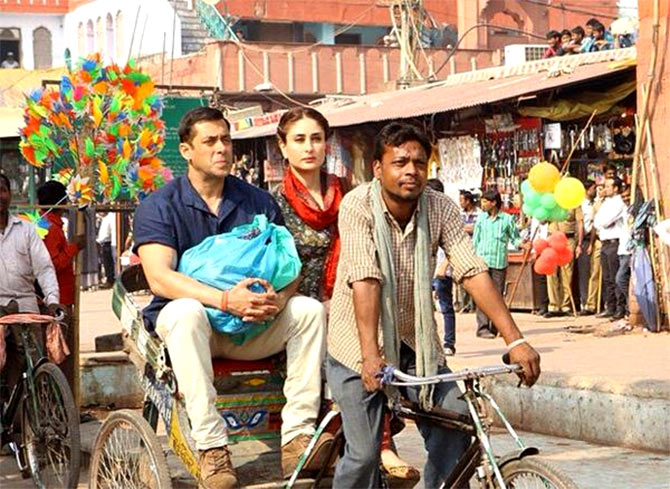
Salman Khan and Kareena Kapoor in a scene from Bajrangi Bhaijaan.
If Salman Khan the superstar discovered Kabir Khan the competent director in Ek Tha Tiger, Kabir Khan the able director has brought out the actor in Salman Khan in Bajrangi Bhaijaan.
This film is certainly not the usual Salman Khan stuff where you have a few unbelievable fight scenes and the inevitable baring of his chest, something that we are so used to seeing when we watch a Salman Khan film.
One can hardly disagree with Kabir Khan when he says that he has tried to show the good values of helping each other on screen through Bajrangi Bhaijaan.
Kabir Khan's films have always touched political issues very intelligently. His treatment of some international themes, especially those touching the lives of Muslims in the contemporary world, has been very sensitive. Kabul Express presented a perspective on Taliban. New York treated the post 9/11 scenario.
The most important aspect of Bajrangi Bhaijaan is the use of humour to touch some sensitive and potentially explosive political-religious and cultural subjects that touch the lives of Indian and Pakistanis.
The film contains a lot of ideology, but it distances itself from that ideology through its deft use of humour. It uses a lot of cultural stereotypes and popularly accepted motifs, but subverts them all to create humorous situations.
In the process it stays away from Pakistan bashing and an easy categorisation of people on the basis of caste, colour, creed and food habits. It presents identity as always in the process, a complex entity, not easily reducible to some fixed concepts.
Thus the easy identification of vegetarianism with Hindus and purity and non-vegetarianism with the image of fiery and impure Muslims is touched with very genial humour to suggest that this binary does not rest on sound wisdom and concrete evidence. Food is definitely one of the markers of identity, but identity is certainly not reducible to one's food habits.
Pavan Kumar Chaturvedi's vegetarianism does not translate into any negative feelings for the little girl when he discovers her gorging on chicken drumsticks even though he could even throw up to see this sight.
What should be the least expected description of identity that a person with an RSS background will bestow on somebody he loves and cares for? Most people will point to a meat-eating Muslim. And an even more apt reply would be a meat-eating Pakistani Muslim.
Son of a father who organised shakhas, Pavan Kumar Chaturvedi (Salman Khan) tries to lessen the enormity of his discovery by rationalising that Kshatriyas are also traditionally meat-eating people. But when faced with the real situation he happily takes the little Muslim girl to a non-vegetarian restaurant.

Bajrangi Bhaijaan makes the point that neither the identity of a person with RSS background nor that of a Pakistani, whether she be a little girl or a seasoned journalist, can be reduced to their food habits. Both can overcome their cultural baggage and discover a different aspect of themselves if faced with a new situation.
In the same way an imam of a Pakistani mosque can be very open-hearted and a humanist to the core, not harbouring any feeling of enmity for anyone. Or, to take another example from the film, Brahmins are not the only Indians to have a light skin.
And since the source of humour often lies in incongruity, the film makes these points humorously, interestingly and without any malice towards anyone. The difference between what is expected and what actually turns out throws many interesting situations in the film. The situational humour is a major strength of Bajrangi Bhaijaan.
Bajrangi Bhaijaan culls out interesting situations from many current discourses. There is little doubt that cricket is followed like a religion in both India and Pakistan. There is an unwritten law in both countries that 'thou shalt not lose to each other.'
Supporting the 'wrong' player, what to say of the 'wrong' team is nothing short of treason and it can result in violence, even death. But even this situation has been turned on its head in the film to create very healthy humour and to press home a point or two about treating sport as sport.
In the 1990s innumerable films, many featuring Sunny Deol, presented a one-dimensional view of Pakistan. But there have been quite a few films like Main Hoon Na and Veer Zara which showed the people of Pakistan rather than Pakistan as synonymous with the Pakistani State. Bajrangi Bhaijaan joins this short list.
But where Bajrangi Bhaijaan really scores is in showing the beautiful locations in Pakistan occupied Kashmir, probably a first of its kind in a big Hindi film. The picture of the beautiful mountains of Switzerland in a calendar that Shahida mistakes for her region is not without some meaning. Kashmir has traditionally been called the Switzerland of the East.
What is unsaid here is even more important. The establishing shot of the film focuses on the beautiful, snow-capped mountains suggesting peace, purity and tranquility. It is really a tragedy that the Switzerland of the East has become what it is even though its common people are like the common people of any other part in India: Full of love and tender feelings.
It goes to Kabir Khan's credit that he treats potentially explosive subjects touching ordinary lives of the people in the subcontinent in a light-hearted manner. As Mark Twain said: 'The secret source of humour itself is not joy but sorrow. There is no humour in heaven.' Khans's rich humour speaks through the six-year-old mute child who belongs to 'the paradise on earth.'
Mohammad Asim Siddiqui teaches English at Aligarh Muslim University.